* On a smartphone, turn your screen to landscape.
* If you hear nothing, turn off silent mode.
- Listen to the reference note that plays first.
- Then listen to the question.
- Use the distance from the reference note as your clue, and answer on the on-screen keyboard.
What Is Ear Training? Relative Pitch Explained
If you have ever thought “I want to play songs by ear” or “I want a better ear for music”, you have probably run into the terms ear training and relative pitch.
They describe the same thing from two angles. Relative pitch is the ability. Ear training is how you build it. Let’s look at what that means, and how it differs from perfect pitch — the two get confused constantly.
Relative Pitch Is About the Distance Between Notes
Relative pitch is the ability to hear the distance between two notes — the interval — rather than the notes themselves.
For example: you hear C, then G, and you recognise it as a fifth. You did not need to know that the first note was a C. You only needed the gap.
That is the whole skill, and it is what ear training drills into you.
Relative Pitch vs Perfect Pitch
| Feature | Relative Pitch | Perfect Pitch |
| How you judge | By comparing against another note | From the note by itself, no comparison needed |
| When you can learn it | Any age — ear training works for adults | Early childhood only, roughly up to age 6 |
| What it does for you | Makes transposing and following chord progressions much easier | You can name any note with no reference |
The key point:
Perfect pitch depends on talent and on what happened in your childhood. Relative pitch does not. Anyone can build it at any age with consistent ear training.
3 Reasons Ear Training Is Worth It
There is a reason musicians say that good relative pitch makes music more fun.
- Playing by ear gets dramatically faster. You start hearing melodies and chords as patterns, so you can reproduce them without sheet music.
- Improvising and writing get easier. You can play the melody in your head straight onto the keyboard.
- Your singing gets more accurate. You hear how your voice sits against the accompaniment, so singing off-key becomes much easier to fix.
What Is Your Level? Try the Relative Pitch Test
Before you start training, it helps to know where you are.
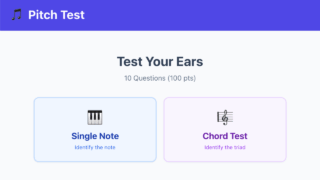
Use the free ear training game at the top of this page. It covers single notes, intervals, and chords across 8 levels, so you can test your whole range of hearing in one place — no sign-up, no download.
Start at Stage 1-1 and work up. If you can clear a stage two or three times in a row, move on.
Ear Training Methods for Beginners
Three things that make relative pitch training stick.
1. Sing in “Movable Do”
Treat the tonic as “Do” no matter what key you are in. This trains you to hear each note’s role in the key rather than its absolute name — which is exactly what relative pitch is.
2. Anchor Each Interval to a Song You Know
Tying an interval to the opening of a song you already know is the fastest shortcut in ear training. Once “the first two notes of that song” means a perfect fourth to you, you will recognise it anywhere.
3. A Few Minutes Every Day, Not an Hour Once a Week
For ear training, five minutes a day beats an hour on Sunday. The skill is built by repetition, not by long sessions.
- Listen to the reference note
- Listen to the question
- Answer on the keyboard
Repeat that cycle like a game, and your brain picks up the distances on its own.
Frequently Asked Questions
How long does ear training take?
Most people notice a difference on simple intervals within a few weeks of short daily sessions. Chords take longer. There is no finish line — even professionals keep training.
Can I train relative pitch as an adult?
Yes. Unlike perfect pitch, relative pitch has no age limit. Most working musicians rely on it rather than on perfect pitch.
Do I need to read sheet music?
No. You answer by clicking keys on the on-screen keyboard, so no notation is involved anywhere in this ear training game.
Which level should I start with?
Stage 1-1, white keys only. Jumping ahead to chords too early is the single most common reason people give up on ear training.
Is it really free?
Yes. No account, no download, no time limit. It runs in your browser on phone, tablet or desktop.
Summary: Keep the Game Going
Relative pitch does not arrive overnight. But if you keep going while enjoying the small win of guessing a note correctly, it will improve — that part is reliable.
The ear training game at the top of this page is built to be solvable with relative pitch alone, with no perfect pitch required. Try five rounds a day and let it become a habit.
Haven’t Tested Your Perfect Pitch Yet?
Relative pitch and perfect pitch are different abilities, and most people have never checked which one they have. The test below takes about two minutes and scores you out of 100.
Just Want to Play Some Notes?
Try the intervals from this page on our free virtual piano — 61 keys, playable with your computer keyboard, with real recorded piano sound.

Want to Play on a Real Piano?
Put on a Meta Quest headset and the notes appear directly above the keys of the digital piano in front of you. Instead of tapping a screen, you play on real keys. That is Sigure, our VR piano game.