* On a smartphone, turn your screen to landscape.
* If you hear nothing, turn off silent mode.
- Pick a mode and a note will play.
- Click the key on the keyboard that matches what you heard.
- After 10 questions you get a perfect pitch score out of 100.
What Is Perfect Pitch? How to Tell If You Have It
Everyone has heard of perfect pitch, but surprisingly few people can say what it actually is.
What Perfect Pitch Actually Means
Perfect pitch — also called absolute pitch — is the ability to name a note the moment you hear it, without comparing it to any reference note first.
Some people even hear everyday sounds as notes: a siren, a microwave beep, or the ring of a glass when you tap it.
Signs You Might Have Perfect Pitch
Even before taking the test, these are the usual signs.
- You can start singing a song in its original key with nothing to guide you.
- You hear everyday sounds — a doorbell, a car horn, a ringtone — as actual notes.
- An out-of-tune instrument bothers you immediately.
Perfect Pitch vs Relative Pitch
These two get confused constantly, but they are completely different abilities.
| Feature | Perfect Pitch | Relative Pitch |
| How you judge | From the note by itself | By comparing it to a reference note |
| When you can learn it | Early childhood, roughly up to age 6 | Any age, including adulthood |
| What it does for you | You can name any note instantly | You follow key changes and melodic shape |
The short version:
For playing and enjoying music, relative pitch is the one that matters. Perfect pitch is closer to a party trick that happens to be useful. That is why most working musicians rely on ear training rather than perfect pitch.
Can Adults Learn Perfect Pitch?
This is the question we get most often.
The Brain’s Critical Period
Perfect pitch is generally acquired through musical training in early childhood, while the brain is still forming those connections.
Because the adult brain is no longer in that window, developing true perfect pitch from scratch is extremely difficult.
Building a “Fixed Do” Reference Instead
What you can build is a kind of pseudo-perfect pitch — reliably recognising specific piano tones.
- Commit one specific note to memory until you can recall it instantly.
- Work out every other note by measuring it against that anchor.
With enough repetition, you can name notes in a way that looks like perfect pitch from the outside. What you are really building is strong relative pitch on top of one memorised anchor — and that is something ear training can give you at any age.
Frequently Asked Questions
Is this perfect pitch test free?
Yes. Nothing to pay, no account to create. Retake it as often as you like.
Is perfect pitch genetic?
The evidence points to both: some genetic predisposition, combined with musical training during early childhood. Neither one on its own appears to be enough.
What counts as a good score?
Scoring 80 or above on the single-note test is unusual. A score below 40 says nothing about your musical ability — relative pitch matters far more for actually playing, and you can train that at any age.
Do I need a piano to take the test?
No. Everything runs in your browser. Headphones will give you a more accurate result than laptop speakers.
Can I take it more than once?
Yes, and you should. The notes are chosen at random each time, so a single run is a rough estimate. Three or four rounds give you a much clearer picture.
Summary: Train Your Ear Like a Game
How did you score?
Whether you got 100 or missed nearly everything, a trained ear stays with you for life.
- Compare scores with friends and family
- Take it once a day and watch your ear sharpen
Treating it like a game is the easiest way to keep going — and consistency is what actually improves your ear.
Next Step: Ear Training You Can Actually Use
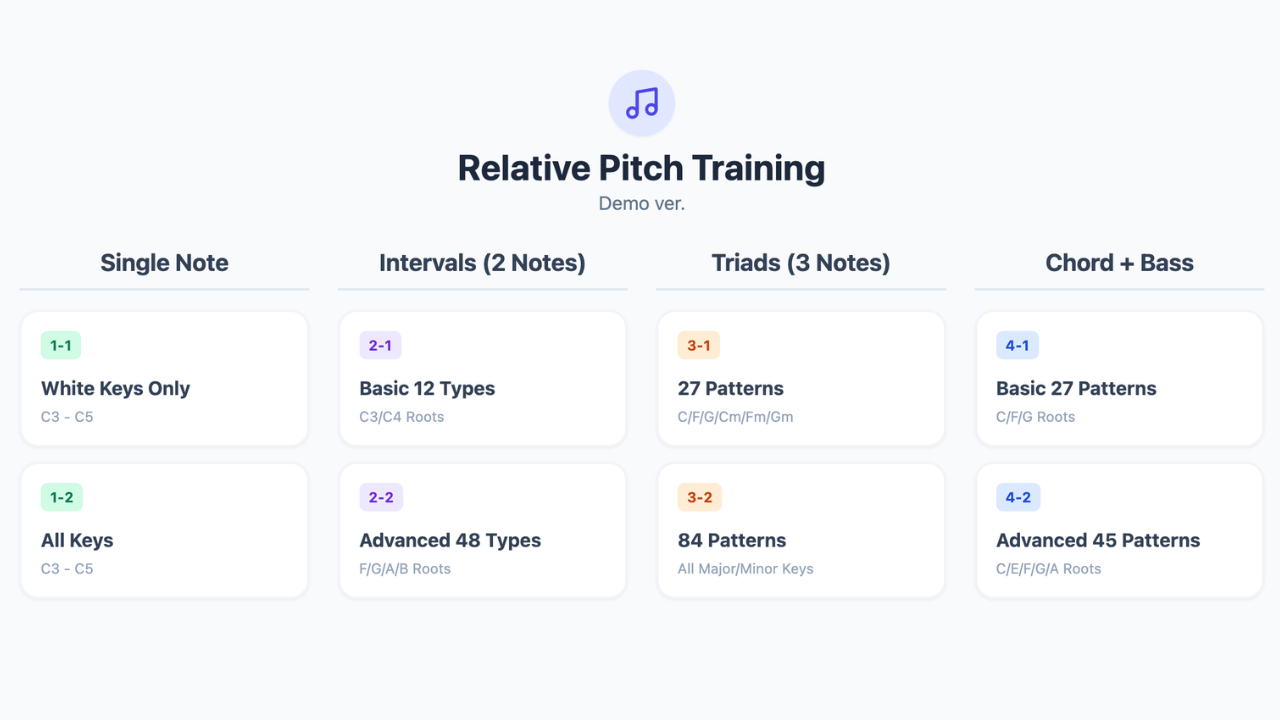
Perfect pitch is mostly fixed by adulthood. Relative pitch is not. If you want to get to the point where you can play a song by ear, this is where to go next — it is free, and there is nothing to install.
Want to Play on a Real Piano?
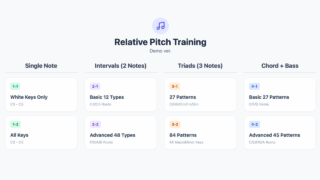
Put on a Meta Quest headset and the notes appear directly above the keys of the digital piano in front of you. Instead of tapping a screen, you play on real keys. That is Sigure, our VR piano game.