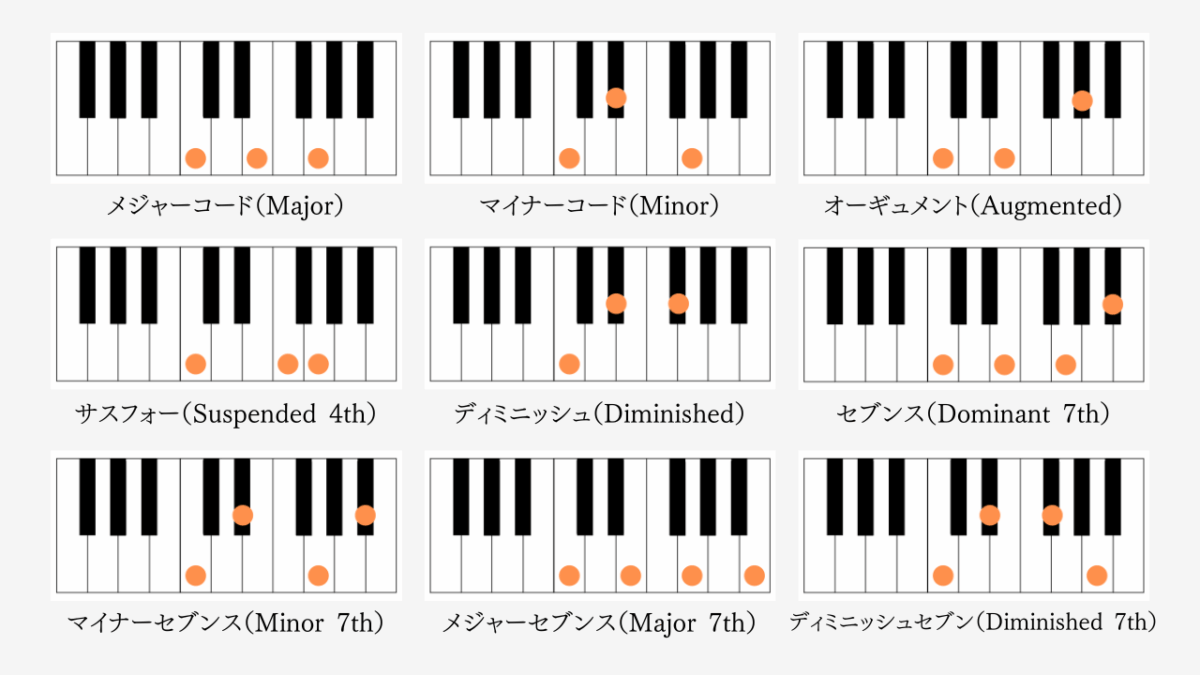
A complete piano chord chart covering Major, Minor, 7th, and more, with an efficient way to learn them.
A chord is basically three or more notes played at the same time. On piano, you can make one just by pressing several keys together, like C, E, and G.
This page lists nine chord types for each of the 12 root notes, each with a keyboard diagram. You can see exactly which keys to press, and hear how each one sounds.
Check the Keys and Sound Instantly
Pick a chord name and the keys to press light up while the piano plays the sound.
Switch to “Find from keys” mode and you can do the reverse — find the chord name from the notes you press. Every keyboard diagram further down this page also plays sound instantly.
*If you don’t hear any sound, turn off silent mode and reload the page.
This tool spells each note the way it would appear on sheet music. For example, Cdim7 is played by pressing C, E♭, G♭, and A, but its correct spelling is C, E♭, G♭, and B♭♭ (B double-flat). The same key can have a different name depending on the chord.
Chord Types
Major Chords
C: C, E, G
The brightest, most stable-sounding chord.
How to remember: from the root, stack a major 3rd (4 semitones), then a minor 3rd (3 semitones).
Minor Chords
Cm: C, E♭, G
A wistful, settled-sounding chord.
How to remember: root ▶︎ minor 3rd (3 semitones) ▶︎ major 3rd (4 semitones).
Tip: lower the 3rd of a Major chord (E) by a half step to E♭, and you get Minor.
Augmented Chords
Caug: C, E, G♯
An unstable, floating chord with a sense of lift.
How to remember: root ▶︎ major 3rd (4 semitones) ▶︎ another major 3rd.
Tip: remember it as “raise the 5th of a Major chord by a half step = Aug.”
Suspended 4th Chords
Csus4: C, F, G
An open sound that makes you want to “resolve” to the next chord.
How to remember: root ▶︎ perfect 4th (5 semitones) ▶︎ major 2nd (2 semitones).
Tip: swap the 3rd of a Major chord (E) for the 4th (F) — say it out loud as “no E, but F” to make it stick.
Diminished Chords
Cdim: C, E♭, G♭
Creates tension, unease, and suspense.
How to remember: root ▶︎ minor 3rd (3 semitones) ▶︎ another minor 3rd.
Dominant 7th Chords
C7: C, E, G, B♭
A staple in blues and jazz, giving a strong sense of forward motion.
How to remember: Major triad (0-4-3) + minor 3rd (3 semitones) = 0-4-3-3.
Tip: think of it simply as “add a ♭7 (B♭) to a Major chord” — that’s the fastest way to remember it in practice.
Minor 7th Chords
Cm7: C, E♭, G, B♭
A melancholic-sounding chord.
How to remember: Minor triad (0-3-4) + minor 3rd (3 semitones) = 0-3-4-3.
Tip: remember it as “Minor plus a ♭7 (B♭).”
Major 7th Chords
CM7: C, E, G, B
A polished, sophisticated sound.
How to remember: Major triad (0-4-3) + major 3rd (4 semitones) = 0-4-3-4.
Tip: contrast it with Dominant 7th — just “restore” the ♭7 back to a natural 7th (B), and you get Major 7th.
Diminished 7th Chords
Cdim7: C, E♭, G♭, A
An eerie chord with strong tension that seems to “pull” you toward resolving into the next chord.
How to remember: stack another minor 3rd (3 semitones) on top of the diminished triad’s 0-3-3 (minor 3rd + minor 3rd), for a total of 0-3-3-3.
Tip: Cdim7 = C–E♭–G♭–B♭♭. Remember it as “stack a ♭♭7 (double-flat 7th) on a dim triad.” On the keyboard you press C, E♭, G♭, and A, and that “A” is spelled B♭♭ in the chord’s proper name.
Since it’s built from perfectly symmetrical minor 3rds, you can shift the same shape three keys at a time and reuse it as four different chords.

Summary: Chords with C as the Root
| Type | Structure (semitones) | Notes (C as root) |
|---|---|---|
| Major | 0-4-3 | C (C, E, G) |
| Minor | 0-3-4 | Cm (C, E♭, G) |
| aug (Augmented) | 0-4-4 | Caug (C, E, G♯) |
| sus4 (Suspended 4th) | 0-5-2 | Csus4 (C, F, G) |
| dim (Diminished) | 0-3-3 | Cdim (C, E♭, G♭) |
| 7th (Dominant 7th) | 0-4-3-3 | C7 (C, E, G, B♭) |
| Minor 7th | 0-3-4-3 | Cm7 (C, E♭, G, B♭) |
| Major 7th | 0-4-3-4 | CM7 (C, E, G, B) |
| dim7 (Diminished 7th) | 0-3-3-3 | Cdim7 (C, E♭, G♭, A) |
Common Chords Not in the List Above
Once you know the nine types above, adding these six will keep you from getting stuck on pop and jazz sheet music. Each one is just adding or swapping a single note in a triad or seventh chord.
| Chord | How it’s built | Example (C as root) |
|---|---|---|
| m7♭5 (Half-diminished) | add a minor 7th to dim | Cm7♭5 (C, E♭, G♭, B♭) |
| 6 (Sixth) | add a major 6th to Major | C6 (C, E, G, A) |
| m6 (Minor sixth) | add a major 6th to Minor | Cm6 (C, E♭, G, A) |
| sus2 (Suspended 2nd) | swap the 3rd for a 2nd | Csus2 (C, D, G) |
| add9 (Added ninth) | add a 9th (= 2nd) to Major | Cadd9 (C, D, E, G) |
| mM7 (Minor-major 7th) | add a major 7th to Minor | CmM7 (C, E♭, G, B) |
These six can also be selected from “Chord type” in the tool above. C6 and Am7 use the same keys, and so do Csus2 and Gsus4. The tool also shows these “same notes, different name” cases.
Inversions: Different Ways to Play the Same Chord
A chord stays the same chord even if you change which note is on the bottom. This rearranging is called an inversion.
| Name | Bottom note | For C |
|---|---|---|
| Root position | Root | C, E, G |
| First inversion | 3rd | E, G, C |
| Second inversion | 5th | G, C, E |
Using inversions keeps your hand from having to move much when the chord changes. For example, moving from C to F in root position makes your hand jump quite a distance, but if you play F as a second inversion (C, F, A), the bottom note “C” doesn’t move at all.
Press “Play” in the tool above and an “Invert” button appears. Each press cycles through first inversion, second inversion, and so on — try comparing how each one sounds.
Chord Chart ( C / D / E / F / G / A / B )
Chords rooted on a black key have two names, like C♯ = D♭. Either way, you press the same key.
C / C♯ / D / D♯ / E / F / F♯ / G / G♯ / A / A♯ / B
Chords with C# (= D♭) as the Root
C# (= D♭) is a black key, and it’s the tonic (Ⅰ) chord in the key of D-flat major. In D-flat major, the four chords used most often are D♭, G♭, A♭, and B♭m.
C♯
C♯ notes: C♯, F, G♯
C♯m
C♯m notes: C♯, E, G♯
C♯aug
C♯aug notes: C♯, F, A
C♯sus4
C♯sus4 notes: C♯, F♯, G♯
C♯dim
C♯dim notes: C♯, E, G
C♯7
C♯7 notes: C♯, F, G♯, B
C♯m7
C♯m7 notes: C♯, E, G♯, B
C♯M7
C♯M7 notes: C♯, F, G♯, C
C♯dim7
C♯dim7 notes: C♯, E, G, B♭
Summary: Chords with C# (= D♭) as the Root
| Type | Structure (semitones) | Notes (C# as root) |
|---|---|---|
| Major | 0-4-3 | C♯ (C♯, F, G♯) |
| Minor | 0-3-4 | C♯m (C♯, E, G♯) |
| aug (Augmented) | 0-4-4 | C♯aug (C♯, F, A) |
| sus4 (Suspended 4th) | 0-5-2 | C♯sus4 (C♯, F♯, G♯) |
| dim (Diminished) | 0-3-3 | C♯dim (C♯, E, G) |
| 7th (Dominant 7th) | 0-4-3-3 | C♯7 (C♯, F, G♯, B) |
| Minor 7th | 0-3-4-3 | C♯m7 (C♯, E, G♯, B) |
| Major 7th | 0-4-3-4 | C♯M7 (C♯, F, G♯, C) |
| dim7 (Diminished 7th) | 0-3-3-3 | C♯dim7 (C♯, E, G, B♭) |
Chords with D as the Root
D is a white key, and it’s the tonic (Ⅰ) chord in the key of D major. In D major, the four chords used most often are D, G, A, and Bm.
D
D notes: D, F♯, A
Dm
Dm notes: D, F, A
Daug
Daug notes: D, F♯, A♯
Dsus4
Dsus4 notes: D, G, A
Ddim
Ddim notes: D, F, A♭
D7
D7 notes: D, F♯, A, C
Dm7
Dm7 notes: D, F, A, C
DM7
DM7 notes: D, F♯, A, C♯
Ddim7
Ddim7 notes: D, F, A♭, B
Summary: Chords with D as the Root
| Type | Structure (semitones) | Notes (D as root) |
|---|---|---|
| Major | 0-4-3 | D (D, F♯, A) |
| Minor | 0-3-4 | Dm (D, F, A) |
| aug (Augmented) | 0-4-4 | Daug (D, F♯, A♯) |
| sus4 (Suspended 4th) | 0-5-2 | Dsus4 (D, G, A) |
| dim (Diminished) | 0-3-3 | Ddim (D, F, A♭) |
| 7th (Dominant 7th) | 0-4-3-3 | D7 (D, F♯, A, C) |
| Minor 7th | 0-3-4-3 | Dm7 (D, F, A, C) |
| Major 7th | 0-4-3-4 | DM7 (D, F♯, A, C♯) |
| dim7 (Diminished 7th) | 0-3-3-3 | Ddim7 (D, F, A♭, B) |
Chords with D# (= E♭) as the Root
D# (= E♭) is a black key, and it’s the tonic (Ⅰ) chord in the key of E-flat major. In E-flat major, the four chords used most often are E♭, A♭, B♭, and Cm.
D♯
D♯ notes: D♯, G, A♯
D♯m
D♯m notes: D♯, F♯, A♯
D♯aug
D♯aug notes: D♯, G, B
D♯sus4
D♯sus4 notes: D♯, G♯, A♯
D♯dim
D♯dim notes: D♯, F♯, A
D♯7
D♯7 notes: D♯, G, A♯, C♯
D♯m7
D♯m7 notes: D♯, F♯, A♯, C♯
D♯M7
D♯M7 notes: D♯, G, A♯, D
D♯dim7
D♯dim7 notes: D♯, F♯, A, C
Summary: Chords with D# (= E♭) as the Root
| Type | Structure (semitones) | Notes (D# as root) |
|---|---|---|
| Major | 0-4-3 | D♯ (D♯, G, A♯) |
| Minor | 0-3-4 | D♯m (D♯, F♯, A♯) |
| aug (Augmented) | 0-4-4 | D♯aug (D♯, G, B) |
| sus4 (Suspended 4th) | 0-5-2 | D♯sus4 (D♯, G♯, A♯) |
| dim (Diminished) | 0-3-3 | D♯dim (D♯, F♯, A) |
| 7th (Dominant 7th) | 0-4-3-3 | D♯7 (D♯, G, A♯, C♯) |
| Minor 7th | 0-3-4-3 | D♯m7 (D♯, F♯, A♯, C♯) |
| Major 7th | 0-4-3-4 | D♯M7 (D♯, G, A♯, D) |
| dim7 (Diminished 7th) | 0-3-3-3 | D♯dim7 (D♯, F♯, A, C) |
Chords with E as the Root
E is a white key, and it’s the tonic (Ⅰ) chord in the key of E major. In E major, the four chords used most often are E, A, B, and C♯m.
E
E notes: E, G♯, B
Em
Em notes: E, G, B
Eaug
Eaug notes: E, G♯, C
Esus4
Esus4 notes: E, A, B
Edim
Edim notes: E, G, B♭
E7
E7 notes: E, G♯, B, D
Em7
Em7 notes: E, G, B, D
EM7
EM7 notes: E, G♯, B, D♯
Edim7
Edim7 notes: E, G, B♭, D♭
Summary: Chords with E as the Root
| Type | Structure (semitones) | Notes (E as root) |
|---|---|---|
| Major | 0-4-3 | E (E, G♯, B) |
| Minor | 0-3-4 | Em (E, G, B) |
| aug (Augmented) | 0-4-4 | Eaug (E, G♯, C) |
| sus4 (Suspended 4th) | 0-5-2 | Esus4 (E, A, B) |
| dim (Diminished) | 0-3-3 | Edim (E, G, B♭) |
| 7th (Dominant 7th) | 0-4-3-3 | E7 (E, G♯, B, D) |
| Minor 7th | 0-3-4-3 | Em7 (E, G, B, D) |
| Major 7th | 0-4-3-4 | EM7 (E, G♯, B, D♯) |
| dim7 (Diminished 7th) | 0-3-3-3 | Edim7 (E, G, B♭, D♭) |
Chords with F as the Root
F is a white key, and it’s the tonic (Ⅰ) chord in the key of F major. In F major, the four chords used most often are F, B♭, C, and Dm.
F
F notes: F, A, C
Fm
Fm notes: F, A♭, C
Faug
Faug notes: F, A, C♯
Fsus4
Fsus4 notes: F, B♭, C
Fdim
Fdim notes: F, A♭, B
F7
F7 notes: F, A, C, E♭
Fm7
Fm7 notes: F, A♭, C, E♭
FM7
FM7 notes: F, A, C, E
Fdim7
Fdim7 notes: F, A♭, B, D
Summary: Chords with F as the Root
| Type | Structure (semitones) | Notes (F as root) |
|---|---|---|
| Major | 0-4-3 | F (F, A, C) |
| Minor | 0-3-4 | Fm (F, A♭, C) |
| aug (Augmented) | 0-4-4 | Faug (F, A, C♯) |
| sus4 (Suspended 4th) | 0-5-2 | Fsus4 (F, B♭, C) |
| dim (Diminished) | 0-3-3 | Fdim (F, A♭, B) |
| 7th (Dominant 7th) | 0-4-3-3 | F7 (F, A, C, E♭) |
| Minor 7th | 0-3-4-3 | Fm7 (F, A♭, C, E♭) |
| Major 7th | 0-4-3-4 | FM7 (F, A, C, E) |
| dim7 (Diminished 7th) | 0-3-3-3 | Fdim7 (F, A♭, B, D) |
Chords with F# (= G♭) as the Root
F# (= G♭) is a black key, and it’s the tonic (Ⅰ) chord in the key of F-sharp major. In F-sharp major, the four chords used most often are F♯, B, C♯, and D♯m.
F♯
F♯ notes: F♯, A♯, C♯
F♯m
F♯m notes: F♯, A, C♯
F♯aug
F♯aug notes: F♯, A♯, D
F♯sus4
F♯sus4 notes: F♯, B, C♯
F♯dim
F♯dim notes: F♯, A, C
F♯7
F♯7 notes: F♯, A♯, C♯, E
F♯m7
F♯m7 notes: F♯, A, C♯, E
F♯M7
F♯M7 notes: F♯, A♯, C♯, F
F♯dim7
F♯dim7 notes: F♯, A, C, E♭
Summary: Chords with F# (= G♭) as the Root
| Type | Structure (semitones) | Notes (F# as root) |
|---|---|---|
| Major | 0-4-3 | F♯ (F♯, A♯, C♯) |
| Minor | 0-3-4 | F♯m (F♯, A, C♯) |
| aug (Augmented) | 0-4-4 | F♯aug (F♯, A♯, D) |
| sus4 (Suspended 4th) | 0-5-2 | F♯sus4 (F♯, B, C♯) |
| dim (Diminished) | 0-3-3 | F♯dim (F♯, A, C) |
| 7th (Dominant 7th) | 0-4-3-3 | F♯7 (F♯, A♯, C♯, E) |
| Minor 7th | 0-3-4-3 | F♯m7 (F♯, A, C♯, E) |
| Major 7th | 0-4-3-4 | F♯M7 (F♯, A♯, C♯, F) |
| dim7 (Diminished 7th) | 0-3-3-3 | F♯dim7 (F♯, A, C, E♭) |
Chords with G as the Root
G is a white key, and it’s the tonic (Ⅰ) chord in the key of G major. In G major, the four chords used most often are G, C, D, and Em.
G
G notes: G, B, D
Gm
Gm notes: G, B♭, D
Gaug
Gaug notes: G, B, D♯
Gsus4
Gsus4 notes: G, C, D
Gdim
Gdim notes: G, B♭, D♭
G7
G7 notes: G, B, D, F
Gm7
Gm7 notes: G, B♭, D, F
GM7
GM7 notes: G, B, D, F♯
Gdim7
Gdim7 notes: G, B♭, D♭, E
Summary: Chords with G as the Root
| Type | Structure (semitones) | Notes (G as root) |
|---|---|---|
| Major | 0-4-3 | G (G, B, D) |
| Minor | 0-3-4 | Gm (G, B♭, D) |
| aug (Augmented) | 0-4-4 | Gaug (G, B, D♯) |
| sus4 (Suspended 4th) | 0-5-2 | Gsus4 (G, C, D) |
| dim (Diminished) | 0-3-3 | Gdim (G, B♭, D♭) |
| 7th (Dominant 7th) | 0-4-3-3 | G7 (G, B, D, F) |
| Minor 7th | 0-3-4-3 | Gm7 (G, B♭, D, F) |
| Major 7th | 0-4-3-4 | GM7 (G, B, D, F♯) |
| dim7 (Diminished 7th) | 0-3-3-3 | Gdim7 (G, B♭, D♭, E) |
Chords with G# (= A♭) as the Root
G# (= A♭) is a black key, and it’s the tonic (Ⅰ) chord in the key of A-flat major. In A-flat major, the four chords used most often are A♭, D♭, E♭, and Fm.
G♯
G♯ notes: G♯, C, D♯
G♯m
G♯m notes: G♯, B, D♯
G♯aug
G♯aug notes: G♯, C, E
G♯sus4
G♯sus4 notes: G♯, C♯, D♯
G♯dim
G♯dim notes: G♯, B, D
G♯7
G♯7 notes: G♯, C, D♯, F♯
G♯m7
G♯m7 notes: G♯, B, D♯, F♯
G♯M7
G♯M7 notes: G♯, C, D♯, G
G♯dim7
G♯dim7 notes: G♯, B, D, F
Summary: Chords with G# (= A♭) as the Root
| Type | Structure (semitones) | Notes (G# as root) |
|---|---|---|
| Major | 0-4-3 | G♯ (G♯, C, D♯) |
| Minor | 0-3-4 | G♯m (G♯, B, D♯) |
| aug (Augmented) | 0-4-4 | G♯aug (G♯, C, E) |
| sus4 (Suspended 4th) | 0-5-2 | G♯sus4 (G♯, C♯, D♯) |
| dim (Diminished) | 0-3-3 | G♯dim (G♯, B, D) |
| 7th (Dominant 7th) | 0-4-3-3 | G♯7 (G♯, C, D♯, F♯) |
| Minor 7th | 0-3-4-3 | G♯m7 (G♯, B, D♯, F♯) |
| Major 7th | 0-4-3-4 | G♯M7 (G♯, C, D♯, G) |
| dim7 (Diminished 7th) | 0-3-3-3 | G♯dim7 (G♯, B, D, F) |
Chords with A as the Root
A is a white key, and it’s the tonic (Ⅰ) chord in the key of A major. In A major, the four chords used most often are A, D, E, and F♯m.
A
A notes: A, C♯, E
Am
Am notes: A, C, E
Aaug
Aaug notes: A, C♯, F
Asus4
Asus4 notes: A, D, E
Adim
Adim notes: A, C, E♭
A7
A7 notes: A, C♯, E, G
Am7
Am7 notes: A, C, E, G
AM7
AM7 notes: A, C♯, E, G♯
Adim7
Adim7 notes: A, C, E♭, G♭
Summary: Chords with A as the Root
| Type | Structure (semitones) | Notes (A as root) |
|---|---|---|
| Major | 0-4-3 | A (A, C♯, E) |
| Minor | 0-3-4 | Am (A, C, E) |
| aug (Augmented) | 0-4-4 | Aaug (A, C♯, F) |
| sus4 (Suspended 4th) | 0-5-2 | Asus4 (A, D, E) |
| dim (Diminished) | 0-3-3 | Adim (A, C, E♭) |
| 7th (Dominant 7th) | 0-4-3-3 | A7 (A, C♯, E, G) |
| Minor 7th | 0-3-4-3 | Am7 (A, C, E, G) |
| Major 7th | 0-4-3-4 | AM7 (A, C♯, E, G♯) |
| dim7 (Diminished 7th) | 0-3-3-3 | Adim7 (A, C, E♭, G♭) |
Chords with A# (= B♭) as the Root
A# (= B♭) is a black key, and it’s the tonic (Ⅰ) chord in the key of B-flat major. In B-flat major, the four chords used most often are B♭, E♭, F, and Gm.
A♯
A♯ notes: A♯, D, F
A♯m
A♯m notes: A♯, C♯, F
A♯aug
A♯aug notes: A♯, D, F♯
A♯sus4
A♯sus4 notes: A♯, D♯, F
A♯dim
A♯dim notes: A♯, C♯, E
A♯7
A♯7 notes: A♯, D, F, G♯
A♯m7
A♯m7 notes: A♯, C♯, F, G♯
A♯M7
A♯M7 notes: A♯, D, F, A
A♯dim7
A♯dim7 notes: A♯, C♯, E, G
Summary: Chords with A# (= B♭) as the Root
| Type | Structure (semitones) | Notes (A# as root) |
|---|---|---|
| Major | 0-4-3 | A♯ (A♯, D, F) |
| Minor | 0-3-4 | A♯m (A♯, C♯, F) |
| aug (Augmented) | 0-4-4 | A♯aug (A♯, D, F♯) |
| sus4 (Suspended 4th) | 0-5-2 | A♯sus4 (A♯, D♯, F) |
| dim (Diminished) | 0-3-3 | A♯dim (A♯, C♯, E) |
| 7th (Dominant 7th) | 0-4-3-3 | A♯7 (A♯, D, F, G♯) |
| Minor 7th | 0-3-4-3 | A♯m7 (A♯, C♯, F, G♯) |
| Major 7th | 0-4-3-4 | A♯M7 (A♯, D, F, A) |
| dim7 (Diminished 7th) | 0-3-3-3 | A♯dim7 (A♯, C♯, E, G) |
Chords with B as the Root
B is a white key, and it’s the tonic (Ⅰ) chord in the key of B major. In B major, the four chords used most often are B, E, F♯, and G♯m.
B
B notes: B, D♯, F♯
Bm
Bm notes: B, D, F♯
Baug
Baug notes: B, D♯, G
Bsus4
Bsus4 notes: B, E, F♯
Bdim
Bdim notes: B, D, F
B7
B7 notes: B, D♯, F♯, A
Bm7
Bm7 notes: B, D, F♯, A
BM7
BM7 notes: B, D♯, F♯, A♯
Bdim7
Bdim7 notes: B, D, F, A♭
Summary: Chords with B as the Root
| Type | Structure (semitones) | Notes (B as root) |
|---|---|---|
| Major | 0-4-3 | B (B, D♯, F♯) |
| Minor | 0-3-4 | Bm (B, D, F♯) |
| aug (Augmented) | 0-4-4 | Baug (B, D♯, G) |
| sus4 (Suspended 4th) | 0-5-2 | Bsus4 (B, E, F♯) |
| dim (Diminished) | 0-3-3 | Bdim (B, D, F) |
| 7th (Dominant 7th) | 0-4-3-3 | B7 (B, D♯, F♯, A) |
| Minor 7th | 0-3-4-3 | Bm7 (B, D, F♯, A) |
| Major 7th | 0-4-3-4 | BM7 (B, D♯, F♯, A♯) |
| dim7 (Diminished 7th) | 0-3-3-3 | Bdim7 (B, D, F, A♭) |
The Order to Learn Chords
You don’t need to learn all 108 chords (12 roots × 9 types) at once. Learning them in this order lets you start using each one in songs right away.
- Major C, F, and G (white keys only)
- Minor Am, Dm, and Em (with these, you can play most children’s songs and pop tunes)
- 7th chords (start with the G7 → C progression)
- sus4 (just placing Gsus4 right before G7 makes it sound like real music)
- Black-key roots (the shape is the same as white keys — only the position shifts)
You’ll learn chords faster by learning them together with how they’re arranged (chord progressions) rather than one at a time, because you start to feel how the same four chords can play many different songs.
So how do you choose those “same four” chords?
In fact, the chords used in a song are narrowed down to seven per key. In C major, that’s the seven chords you can build using only white keys: C, Dm, Em, F, G, Am, and Bdim. These seven are called diatonic chords.
Instead of choosing from 108 chords, you’re choosing from seven. Once you can think this way, the chords you’ve learned suddenly turn into real songs.

Related Articles
- What Is a Chord Progression? 5 Classic Patterns Explained with Chart and Sound — how to arrange the chords you’ve learned into a song
- Canon progression / Royal Road progression / Komuro progression — three commonly used progressions
- How to Learn and Use the Circle of Fifths — see at a glance which chords go with which key
- How to Read Treble and Bass Clef — for connecting chord names on sheet music to actual notes
- A List of Music Symbols — a rundown of symbols like ♯, ♭, and natural marks on sheet music
FAQ
Which chords are used most often on piano?
In pop music, the four that come up most are C, F, G, and Am in the key of C major. Plenty of songs can be played with just these four. The “Ⅰ·Ⅳ·Ⅴ·Ⅵm” relationship stays the same even when the key changes, so each root’s section above lists the four chords used most often in that key.
What is a chord on piano?
It’s three or more notes of different pitches played at the same time. On piano, you can make one just by pressing keys together, like C, E, and G. Chords form the foundation of the accompaniment that supports a melody.
How many piano chords are there in total?
It depends how you count, but this page shows 12 root notes × 9 types = 108 chords with keyboard diagrams. The tool above lets you check 15 types × 12 roots = 180 chords once you add m7♭5, 6, m6, sus2, add9, and mM7. And if you count inversions and slash chords too, the number grows even further.
What order should beginners learn chords in?
Start with C, F, and G, which you can play on white keys alone, then move to Am, Dm, and Em, followed by 7th chords, sus4, and finally black-key roots. For details, see The Order to Learn Chords above.
Final Thoughts
Using this piano chord chart will immediately widen the range of accompaniments you can play.
Learning in the order Major/Minor → 7th → sus4 is the least likely path to make you want to give up.
Once you’ve learned them, apply them to real chord progressions in songs and train your ear and fingers together. If you ever forget how a chord sounds, you can always check it with the tool on this page.