You’re following along with the sheet music, and every few notes you stop and think, “wait, what note is this?” This is where a lot of people get stuck when they start learning piano.
You don’t memorize note positions by trying to memorize them — you get used to them by seeing them over and over until your body just knows. So we built a sight-reading trainer that’s just this: a note appears on the staff, and you answer on the keyboard.
It runs right in your browser. No app to install, no account to create. You can practice both the treble clef and bass clef.
*If you don’t hear any sound, turn off silent mode and reload the page.
- Choose a clef
Pick “Treble Clef” to read the right hand, “Bass Clef” for the left. Choose “Both” to practice them together. - Choose a difficulty
Start with “Easy” for notes with no ledger lines. Once you’re comfortable, move up to “Medium” and “Hard” to include notes on ledger lines. - Answer on the keyboard
Press the key that matches the note shown on the staff. There are 10 questions total, and any notes you missed are shown together at the end.
The sounds are recordings of a real piano. Each note plays the instant you press it, so the position you see connects directly to the pitch you hear.
The Clef’s Name Tells You How to Read It
You don’t need to memorize every note right away. Once you know just one reference note, you can count the rest from there.
And that reference note is built right into the clef’s own name.
| Clef | What It Marks |
|---|---|
| Treble Clef (also called the “G clef”) | The line the spiral curls around is G |
| Bass Clef (also called the “F clef”) | The line between the two dots is F |
That spiral on the treble clef isn’t decoration. It’s a marker saying “the line running through the center of this curl is G.” The two dots on the bass clef work the same way — they mean “the line between these dots is F.”
Once you’ve got this down, the moment you see the clef, you already have one foothold to work from.
Reading Treble Clef (Right Hand, Higher Notes)
In piano music, the treble clef is written on the top staff, and it’s usually the right hand’s part.
Counting up from the bottom of the staff, here’s what each line and space is:
| Position | Note | Position | Note |
|---|---|---|---|
| Ledger line below staff | C (middle C) | Space 3 | C |
| Line 1 | E | Line 4 | D |
| Space 1 | F | Space 4 | E |
| Line 2 | G (center of the clef’s spiral) | Line 5 | F |
| Space 2 | A | ||
| Line 3 | B |
The classic way to learn this is to memorize lines and spaces separately.
- Notes on the lines (bottom to top)…E, G, B, D, F — often remembered with “Every Good Boy Does Fine”
- Notes in the spaces (bottom to top)…F, A, C, E — which conveniently spells “FACE”
But being able to recite this doesn’t actually make you faster at reading music. If you’re still counting “third line from the bottom, so… E, G, B” every single time, you won’t keep up.
The goal is to recognize the shape instantly, without counting. That’s exactly what the trainer above is built for.
Reading Bass Clef (Left Hand, Lower Notes)
The bass clef is written on the bottom staff, and it’s usually the left hand’s part.
The tricky part is that the same position on the staff means a completely different note than it does in treble clef. The middle line, for example, is B in treble clef but D in bass clef.
| Position | Note | Position | Note |
|---|---|---|---|
| Line 1 | G | Line 4 | F (the line between the two dots) |
| Space 1 | A | Space 4 | G |
| Line 2 | B | Line 5 | A |
| Space 2 | C | Ledger line above staff | C (middle C) |
| Line 3 | D | ||
| Space 3 | E |
- Notes on the lines (bottom to top)…G, B, D, F, A — a common mnemonic is “Good Boys Do Fine Always”
- Notes in the spaces (bottom to top)…A, C, E, G — remembered as “All Cows Eat Grass”
Bass clef tends to get put off, but you can’t play a piece if you can’t read the left hand. Once you can read treble clef reasonably well, start on bass clef sooner rather than later.
Middle C Connects the Two Staves
Piano music uses treble and bass clef together, as two staves. This paired arrangement is called the grand staff.
And the key that connects the two is middle C.
| Where It’s Written | Position of Middle C |
|---|---|
| Treble clef (top staff) | One ledger line below the staff |
| Bass clef (bottom staff) | One ledger line above the staff |
The bottom of the top staff and the top of the bottom staff meet at middle C. Once you see it that way, the two staves stop looking like two separate systems and start looking like one continuous run of notes.
If you want to check the position on an actual keyboard, you can also use this.

How to Read Ledger Lines
Notes that fall outside the staff get short extra lines added to them. These are called ledger lines.
A lot of people suddenly feel lost once there are two or three ledger lines, but the rule itself is simple.
- Ledger lines are just a continuation of the staff, spaced the same way
- They go line → space → line → space, alternating up one note at a time
- When counting, it’s safest to start counting from the edge of the staff
In treble clef, for example, the fifth line is F. The space above it is G, the first ledger line above that is A… and so on.
In the trainer above, “Medium” includes up to one ledger line, and “Hard” goes up to two. Work through them in order to build up gradually.
4 Tips for Faster Sight-Reading
1. Five Minutes Daily Beats One Hour on the Weekend
Sight-reading is reflex, not knowledge. Five minutes every day sticks far better than one hour crammed into a weekend. The trainer above is set up so 10 questions take about a minute.
2. Don’t Settle for “I Got It by Counting”
Counting “E, G, B…” will always get you to the right answer eventually. But if you stop there, you’ll keep counting forever.
When you hesitate on a note, go back and repeat just that note a few times until you re-learn it by shape.
3. Practice Pitch and Rhythm Separately
Struggling with sight-reading usually comes down to one of two things.
- Not knowing the pitch → the trainer on this page
- Not knowing the note value or rhythm → practicing note durations
Try to fix both at once and you’ll end up half-improving each one. Decide which one you’re working on today before you start.

4. Open the Sheet Music for a Song You Want to Play, Early
If you only work through a method book, it’s easy to lose sight of why you’re learning to read music at all.
It’s fine if you can’t play it yet. Open the sheet music for a song you like and just read the note names for the first measure. That alone changes what the practice means to you.
![10 Easy Classical Piano Songs for Beginners [Free PDF Sheet Music]](https://vrpiano.co.jp/wp-content/uploads/2025/06/ピアノ初心者向け-簡単クラシック楽譜10曲【無料PDF】-320x180.png)
FAQ
Q1. Do I need to install an app to use it?
A. No. The trainer embedded on this page runs entirely in your browser. No download, no account. It works the same way on smartphones and computers.
Q2. Which should I learn first, treble or bass clef?
A. Generally, treble clef first — it usually carries the melody, so you’ll run into it more often.
That said, waiting until treble clef is perfect before touching bass clef isn’t a great plan. Once you can read treble clef about halfway well, start bass clef alongside it. You’ll need both eventually to play with two hands.
Q3. How long does it take to learn to read it?
A. It varies a lot from person to person, so there’s no honest “you’ll have it in X days” answer.
But you can use how often you hesitate as a guideline. If you hesitate twice or fewer out of 10 questions, that difficulty level is solid — move on. If you hesitate five or more times, you’re still in that stage.
Q4. Will this help me understand note values (how many beats to hold a note)?
A. This trainer is pitch only. It doesn’t cover note duration.
For whole notes, quarter notes, rests, and other durations, we cover that in a separate article.

Q5. Can I practice notes with sharps and flats too?
A. Check “Include ♯ (black keys)” and sharped notes will show up too. We’d recommend mastering the white keys first with the box unchecked, then adding this in.
More Free Tools to Use Alongside This
- Online Metronome for Piano…comes with practice tempos by song. For when you want to lock in your rhythm
- Virtual Piano…play the keys right in your browser. For checking where a note actually sits
- Perfect Pitch Test…see if you can name a note just by ear
- Relative Pitch Training…practice telling the distance between two notes
- List of Music Symbols…look up any symbol you run into on a score
Summary
- Treble clef marks “G,” bass clef marks “F” — the clef itself tells you the position
- Using middle C as your anchor point, the two staves start to look like one continuous system
- Ledger lines are just a continuation of the staff — line → space → line, alternating up one note at a time
- Keep repeating a little every day until you recognize the shape instead of counting it out
Sight-reading comes down to repetition, not talent. Keep at it for five minutes a day, and one day it’ll just click — you’ll know the note without counting.
Until that day, use this page as your practice ground.
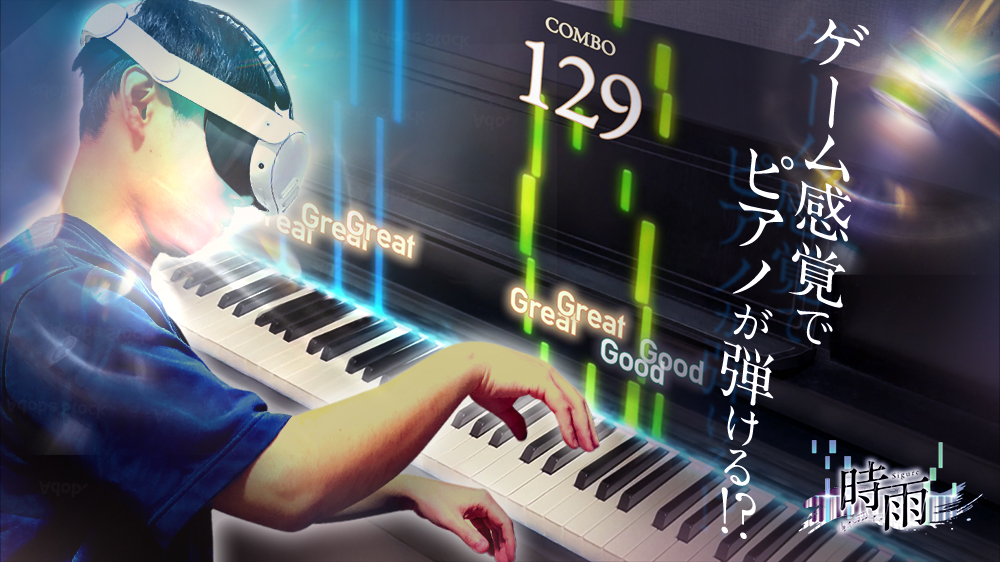
And if you’d like to try playing piano before you can read music at all, there’s also a VR piano game. No sheet music required — just press the keys in time with the falling notes, and it becomes a song.