You’ve learned the names of the notes, but when you actually play, the rhythm falls apart. Half the reason people get stuck on piano isn’t pitch — it’s this.
You won’t pick up rhythm by staring at a chart. The fastest way is to actually move your hands and feel what it’s like to drift off the beat.
So we built a rhythm trainer that isolates just the note lengths for practice. It runs right in your browser. No app to install, no account to create.
If you can’t hear anything, turn off silent mode and reload the page.
- Length Quiz
A note or rest appears and you choose how many beats it’s worth. Start here. 10 questions, about a minute. - Rhythm Tap
A one-bar rhythm appears, and after a count-in you tap the button. For half notes, whole notes, and dotted notes, you have to hold the button down for the full length to get it right. 6 bars total.
In Rhythm Tap, it even shows how many milliseconds off your timing was. A tendency to rush or drag is hard to notice on your own.
Every device has its own audio delay, and you can measure and offset it from “Calibrate Latency” on the home screen. Bluetooth earbuds add a 0.1–0.3 second delay, so we recommend wired earbuds or your device’s built-in speaker.
Quick Reference: Note and Rest Lengths
Let’s start with the big picture. Here are the lengths with a quarter note counted as one beat.
| Note | Rest | Length | In quarter notes |
|---|---|---|---|
| Whole note | Whole rest | 4 beats | 4 |
| Dotted half note | Dotted half rest | 3 beats | 3 |
| Half note | Half rest | 2 beats | 2 |
| Dotted quarter note | Dotted quarter rest | 1.5 beats | 1½ |
| Quarter note | Quarter rest | 1 beat | 1 |
| Dotted eighth note | Dotted eighth rest | 0.75 beats | ¾ |
| Eighth note | Eighth rest | 0.5 beats | ½ |
| Sixteenth note | Sixteenth rest | 0.25 beats | ¼ |
The trick to remembering these is to treat the quarter note as your baseline and think in terms of doubling or halving. Trying to memorize the list top to bottom just makes it more confusing.
- Double a quarter note and you get a half note, four times gives you a whole note
- Half a quarter note gives you an eighth note, a quarter of it gives you a sixteenth note
A “beat” isn’t always a quarter note
The table above holds for time signatures where the bottom number is “4” — 4/4, 3/4, 2/4, and so on.
The bottom number in a time signature tells you which note value counts as one beat. In 6/8 time, for example, an eighth note is one beat.
If you’ve just memorized “an eighth note is 0.5 beats,” this is where it trips you up. Treat the numbers in the table as a ratio with the quarter note set to 1, not as an absolute length.
A whole rest is often explained as “rest for 4 beats,” but in actual sheet music it means rest for the entire bar.
So if a whole rest appears in a bar of 3/4 time, you rest for 3 beats. Don’t count out 4 and wait.
A Dot Means “the Original Length Plus Half of It”
A note with a small dot to its right is a dotted note. Its length is the original note plus half of that note.
| Dotted note | Calculation | Length |
|---|---|---|
| Dotted half note | 2 beats + half of that (1 beat) | 3 beats |
| Dotted quarter note | 1 beat + half of that (0.5 beats) | 1.5 beats |
| Dotted eighth note | 0.5 beats + half of that (0.25 beats) | 0.75 beats |
The easy mistake is misreading what the “half” refers to. You add half of that same note’s value — not half of the next-shorter note.
For a dotted quarter note, you add half of a quarter note — 0.5 beats. It might be quickest to just remember: a dot always makes the length ×1.5.
Three Reasons Your Rhythm Falls Apart
The Rhythm Tap tool above measures the gap between when you tapped and when you should have, down to the millisecond. Three things tend to trip people up.
1. Watching the note shape instead of counting the beat
If you think “this is an eighth note, so play it fast,” your speed might be right but the placement will be off. Rhythm isn’t decided by the note itself — it’s decided by where it falls within the beat.
The fix is simple: count out loud. When eighth notes show up, split each beat in two and count “one-and, two-and, three-and, four-and.”
2. Cutting long notes short
This is the most common habit of all. When a half note or whole note comes up, people get anxious about the next note and lift their finger too soon.
The sound cuts off but the beat keeps moving, so it ends up sounding vaguely thin. The player usually doesn’t notice.
The reason Rhythm Tap makes you hold long notes down is to expose exactly this habit. If you let go too soon, the results will show how many times you did it.
3. Not waiting through rests
A rest isn’t “doing nothing” — it’s playing silence. But when nothing is sounding, it’s easy to get anxious and jump into the next note too soon.
Keep counting the beat in your head through the rest too. The trick is to never stop the count, even with your hands off the keys.
How to Build Your Sense of Rhythm
Clap it out before you play
Jumping straight to the keyboard means handling fingering, pitch, and rhythm all at once — that’s too much for your brain to juggle.
First, look at the score and clap out just the rhythm. That alone makes a clear difference once you actually play. Rhythm Tap above turns exactly this exercise into a game.
Build a run with zero mistakes at a slow tempo
Usually, the reason you can’t play fast is that you can’t play accurately even slowly.
Once you can play through at a slow tempo without a single mistake, nudge the tempo up a little and run it again. Repeating that is, in the end, the fastest path forward. The tool above lets you set the tempo anywhere from 50 to 132.
Use a metronome to notice drift, not just to keep time
Even with a metronome running, your own playing can drown it out and mask any drift.
The trick is to listen for the moment your own note swallows the click. When you’re exactly in sync, the click disappears — that’s the clearest signal you’ll get.

5 minutes daily beats 1 hour on the weekend
A sense of rhythm is a physical reflex, not knowledge. Short daily practice sticks better than one long session.
The Length Quiz above takes about a minute for 10 questions, and Rhythm Tap takes about a minute and a half for 6 bars. Try using them as a warm-up before you start practicing.
Frequently Asked Questions
Q1. Do I need to install an app to use this?
A. No. The trainer embedded on this page runs right in your browser. No download, no account — it works on phones and computers alike.
Q2. The timing judgment feels off
A. Every device has its own delay of tens of milliseconds before sound actually plays. Measure it with “Calibrate Latency” on the home screen. Tap along with the click about 8 times, and that delay gets subtracted from the judging.
That said, Bluetooth adds a 0.1–0.3 second delay of its own, and some drift remains even after calibrating. We recommend wired earbuds or your device’s built-in speaker.
Q3. Why do I have to hold down long notes?
A. On a real piano, a half note means holding the key down for 2 full beats. If a single tap counted as correct, you’d never build that feel.
That said, releasing a little early to reach the next note is completely normal in real playing, so releasing up to 3/4 of a beat early still counts as correct. Holding too long is judged more strictly, since it bleeds into the next note.
Q4. Can I practice pitch (Do Re Mi) too?
A. This trainer is dedicated to note length and rhythm only. It doesn’t cover pitch.
You can practice reading the treble and bass clefs on a separate page.

Q5. I don’t even know the note shapes and names yet
A. The look and name of each note — whole notes, quarter notes, rests, and so on — are laid out with diagrams in a separate article. Reading that first, then coming back here, will make the trainer above much easier.

Q6. Can I practice in 3/4 time too?
A. Choose Rhythm Tap and you can pick between 4/4 and 3/4 time. If you want to get used to counting in three, like a waltz, choose 3/4.
Free Tools to Use Alongside This One
- Online Metronome for Piano…… with practice tempos by song. Good for holding a steady tempo
- Note Reading Trainer…… practice reading the treble and bass clefs
- Virtual Piano…… play a keyboard right in your browser
- Music Symbol Glossary…… look up any symbol that shows up in sheet music
- Easy Sheet Music for Beginners…… for when you want to put your practice to use
Summary
- Use the quarter note as your baseline and think in doubles and halves
- A dot adds half of that same note’s value. The result is always ×1.5
- Don’t cut long notes short. This is the single most common habit
- Keep counting through rests too
- Clapping out just the rhythm before you play changes your accuracy
Rhythm isn’t something you can play the moment you understand it in your head. Your body learns the beat only through the number of times you’ve actually moved.
Even just a minute before you practice is fine. Try using the trainer above as today’s warm-up.
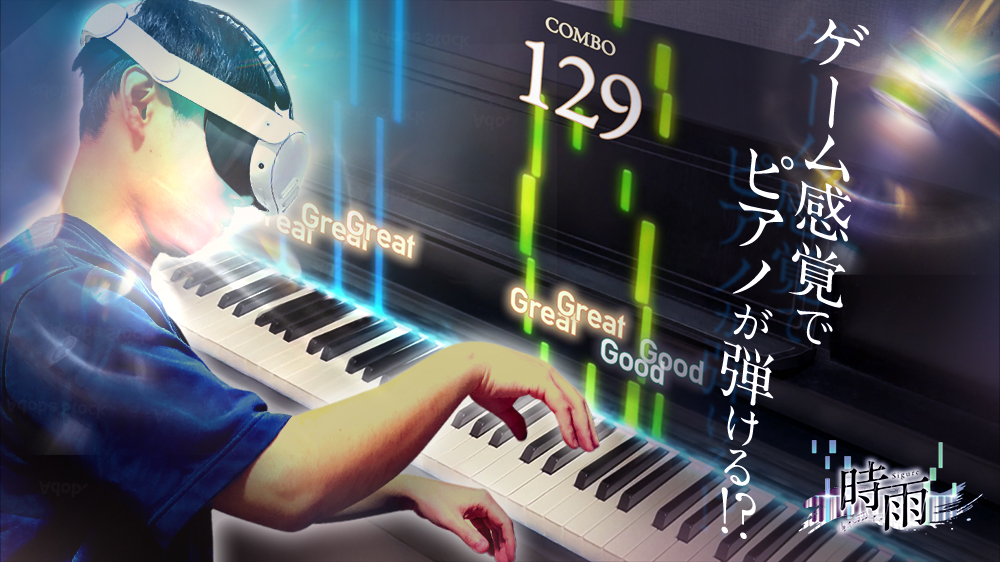
If you’d rather play piano without reading sheet music at all, there’s also our VR piano game. Just press the keys in time with the falling notes and it turns into a song — it’s also a good way in for getting a feel for staying on the beat.