Looking for easy piano sheet music? Here are 10 “Easy Classical” pieces specially arranged for beginners, all available as free PDFs.
These arrangements are designed to balance readability and playability, so start practicing today and make your debut with these masterpieces!
- 10 Easy Classical Pieces – Free Sheet Music
- Frog Chorus / German Folk Song
- Jesu, Joy of Man’s Desiring / J.S. Bach
- Spring from “The Four Seasons” / A. Vivaldi
- Pomp and Circumstance / E. Elgar
- Orpheus in the Underworld (Can-Can) / J. Offenbach
- Gavotte / F.J. Gossec
- Bolero / M. Ravel
- Snail Variations / Japanese Children’s Song
- Ode to Joy / L.v. Beethoven
- Canon / J. Pachelbel
- Free PDF Download List (All 10 Pieces)
- What Makes This Easy Classical Sheet Music Different
- 3 Steps to More Efficient Practice
- FAQ
- Summary
10 Easy Classical Pieces – Free Sheet Music
Frog Chorus / German Folk Song
A children’s song often sung as a round. Based on a German folk tune, it became popular in Japan after appearing in school textbooks.
The simple melody imitates frogs croaking by a pond, and it also makes a good first introduction to harmony.

Jesu, Joy of Man’s Desiring / J.S. Bach
A serene piece taken from Bach’s Church Cantata No. 147.
Play it at a steady tempo with a singing tone to bring out its charm.

Spring from “The Four Seasons” / A. Vivaldi
A piano solo arrangement of the brilliant opening theme of Vivaldi’s concerto “The Four Seasons,” often heard at recitals and school ceremonies.
Play it while picturing the wind and the birds of spring.
Pomp and Circumstance / E. Elgar
The famous Trio section of March No. 1, often performed at British royal events.
The beginner version thins out the chords so that it suits players with smaller hands.
Orpheus in the Underworld (Can-Can) / J. Offenbach
The famous theme from the overture to Offenbach’s operetta “Orpheus in the Underworld,” a lively tune well known from school sports days.
In the beginner version the right hand is simplified and the left hand is easy to play. Start slowly and gradually speed up to build a solid sense of rhythm.
Gavotte / F.J. Gossec
Gossec’s Gavotte, an 18th-century French court dance, features a bouncing rhythm with light accents on the weak beats and an elegant melody.
The beginner arrangement centers on the right-hand melody and simplifies the left hand.
Bolero / M. Ravel
Ravel’s 1928 orchestral work repeats a single rhythm and melody while gradually building in instrumentation and volume.
The beginner version uses a simple left-hand rhythm and keeps the right-hand melody within one to two octaves, so it is dramatic yet approachable.
Snail Variations / Japanese Children’s Song
A short set of variations on the Japanese children’s song “Snail” (Katatsumuri).
Colorful, easy to play, and fun to practice at home.
Ode to Joy / L.v. Beethoven
From the final movement of Beethoven’s Symphony No. 9, a timeless melody celebrating humanity, friendship, and love.
In Japan it is a staple of year-end concerts and choirs, and around the world it remains a symbol of peace and hope.
Canon / J. Pachelbel
Pachelbel’s Canon is a serene Baroque masterpiece, beloved at weddings and as relaxing music.

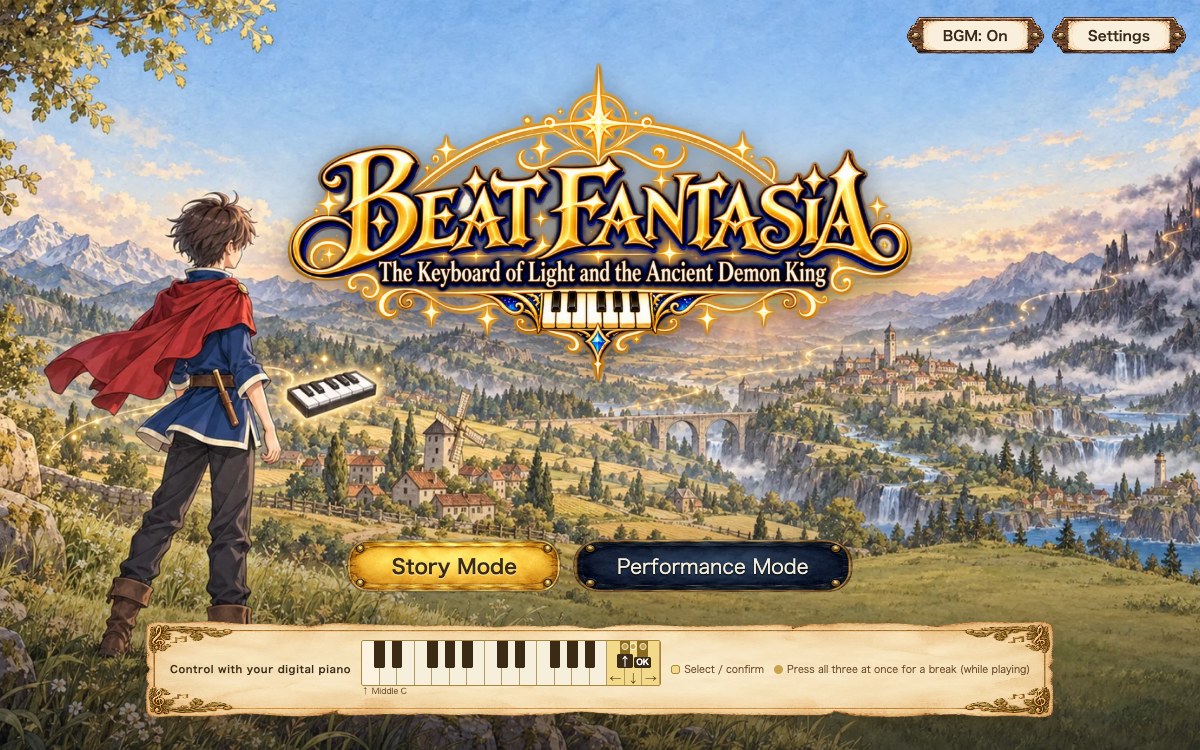
Two of these pieces, “Ode to Joy” and “Jesu, Joy of Man’s Desiring,” are also stages in our browser piano RPG Beat Fantasia. You play along with falling notes that show you which key to press, and STEP1 is free.
Free PDF Download List (All 10 Pieces)
| No. | Title | Composer | Key | Difficulty ★ | |
|---|---|---|---|---|---|
| 1 | Frog Chorus | German Folk Song | F | ★☆☆☆☆ | [DL] |
| 2 | Jesu, Joy of Man’s Desiring | J.S. Bach | G | ★★☆☆☆ | [DL] |
| 3 | Spring from The Four Seasons | A. Vivaldi | G | ★★☆☆☆ | [DL] |
| 4 | Pomp and Circumstance (March No.1 Excerpt) | E. Elgar | G | ★★☆☆☆ | [DL] |
| 5 | Orpheus in the Underworld (Excerpt) | J. Offenbach | C | ★★☆☆☆ | [DL] |
| 6 | Gavotte | F.J. Gossec | D | ★★☆☆☆ | [DL] |
| 7 | Bolero (Theme) | M. Ravel | C | ★★☆☆☆ | [DL] |
| 8 | Snail Variations | Japanese Children’s Song | C | ★☆☆☆☆ | [DL] |
| 9 | Ode to Joy (Symphony No.9) | L.v. Beethoven | D | ★★☆☆☆ | [DL] |
| 10 | Canon | J. Pachelbel | D | ★★☆☆☆ | [DL] |
Transcription & Arrangement: Aya (Piano Teacher)
Free for personal use. For commercial use or redistribution, please contact us separately.
What Makes This Easy Classical Sheet Music Different
- Minimal hand movement — played mostly in the center range of the keyboard.
- Right-hand melody focus — the left hand plays a simple whole-note accompaniment.
- Familiar tunes — easy to practice and motivating to keep going.
3 Steps to More Efficient Practice

① Start with one hand at a tempo of 40–50
Get rid of mistakes at a slow tempo before speeding up — it makes your practice far more efficient.
② Memorize in chunks of 3–4 measures
Short units help you stay focused and lead to a more polished result.
③ Finish with a recording check
Record yourself on your smartphone → listen back objectively → focus your practice on the weak spots.
FAQ

Q. How is this different from commercial sheet music?
A. Complex chords are simplified, and the left hand mainly uses whole notes, making it playable for beginners and those with smaller hands.
Q. I have no piano experience at all. Can I really play?
A. Yes. The arrangements keep the range narrow and are designed so that anyone can play them. Start slowly with the right-hand melody, then add the left hand.
Q. Can I view the sheet music on a smartphone or tablet?
A. Yes, the PDFs can be viewed on iPhone, Android, and iPad. For printing, we recommend A4 at a high-quality setting.
Q. Can I transpose or add finger numbers for my own use?
A. Yes, you are welcome to edit and annotate the scores for your own practice. Adding fingerings can make them even easier to play.
Summary
In this article we introduced 10 easy classical piano pieces, such as “Frog Chorus” and “Jesu, Joy of Man’s Desiring,” arranged so that beginners can enjoy playing masterpieces.
All of them are beginner-friendly arrangements by Aya, with a narrow range that makes them easy even for those who are not yet confident reading sheet music.
Download your favorite piece and make your classical piano debut today!