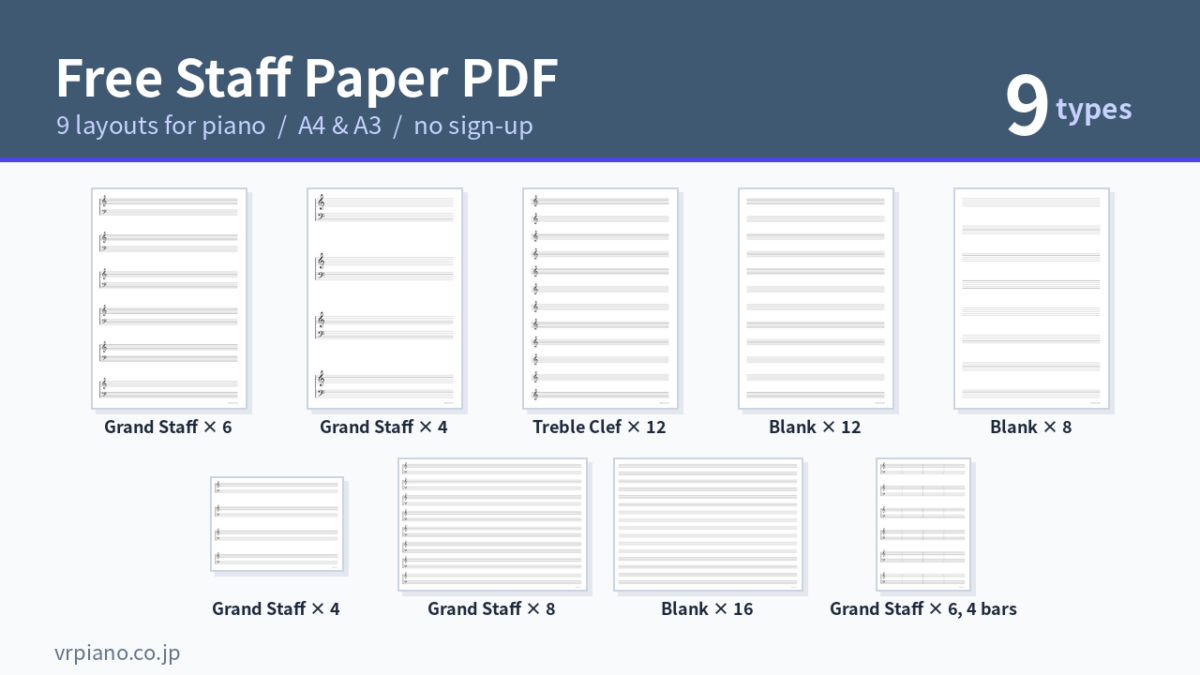
Free staff paper for piano, in nine printable layouts. No sign-up, no email address — press a button and the PDF downloads straight away.
Most of the sheets are grand staff (treble and bass braced together, the way piano music is written). There is A4 and A3, a version with bar lines, and a version with no clefs printed.
Free staff paper PDFs (9 layouts)
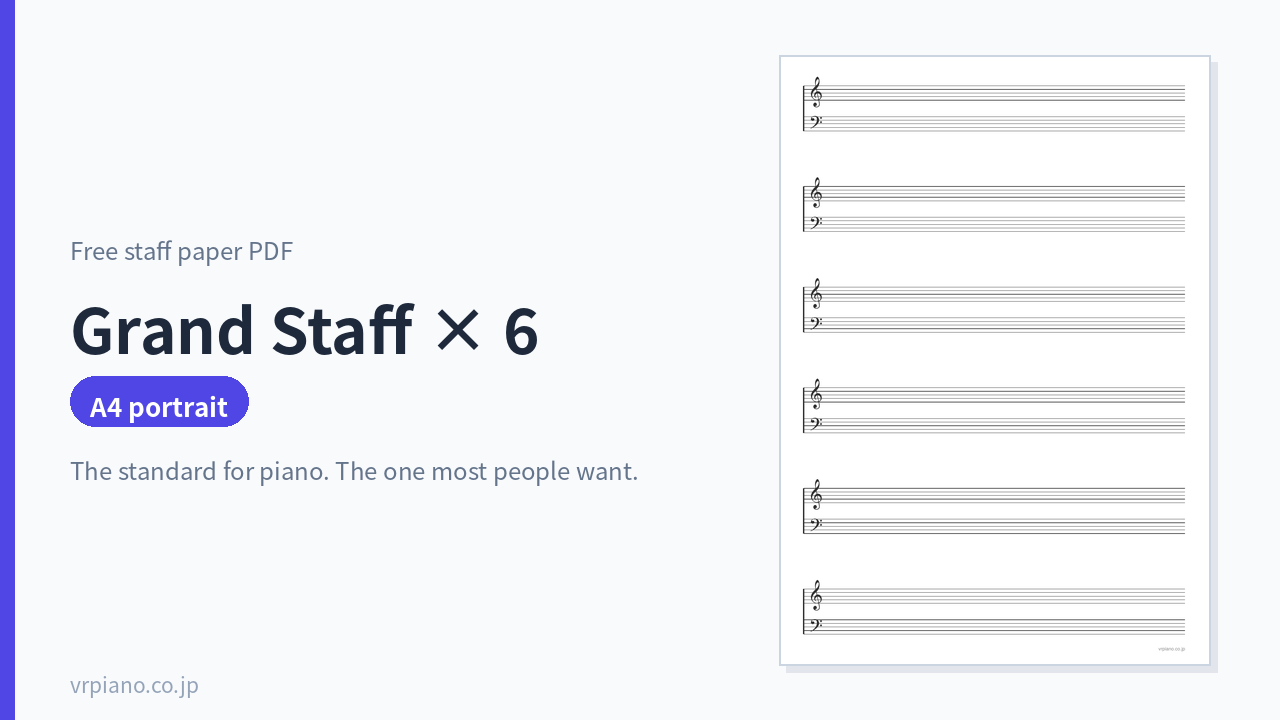
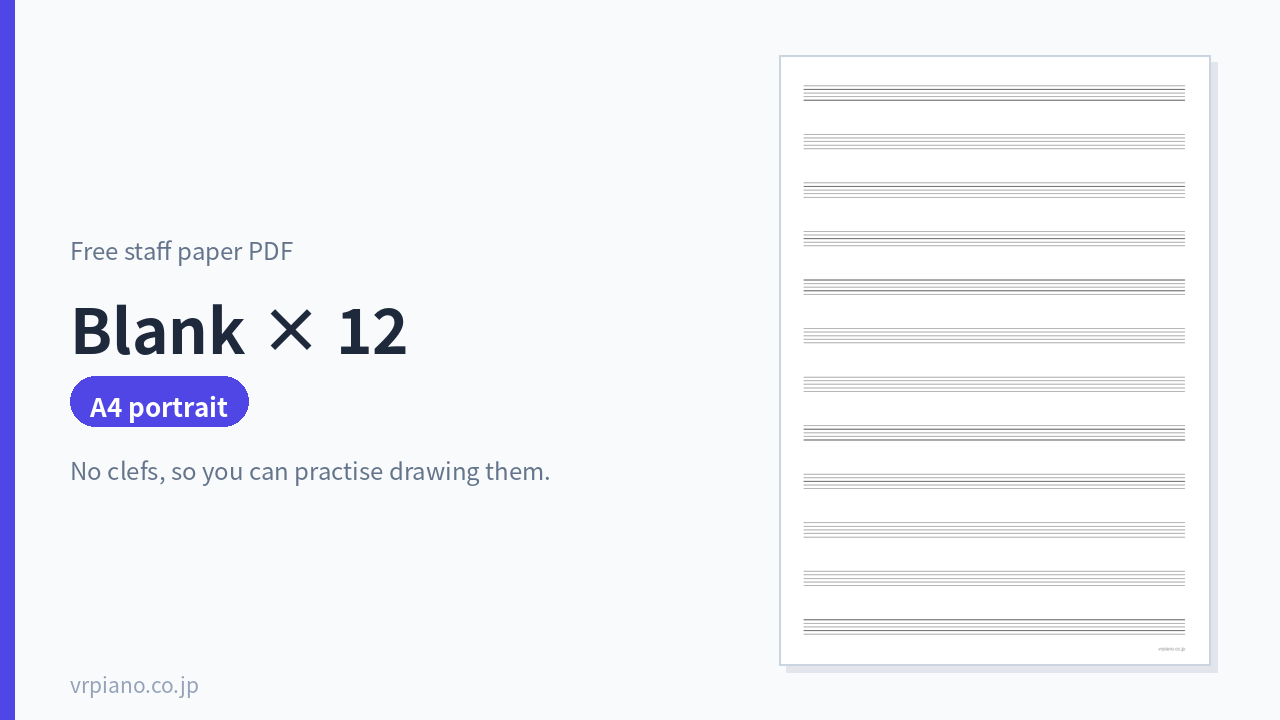
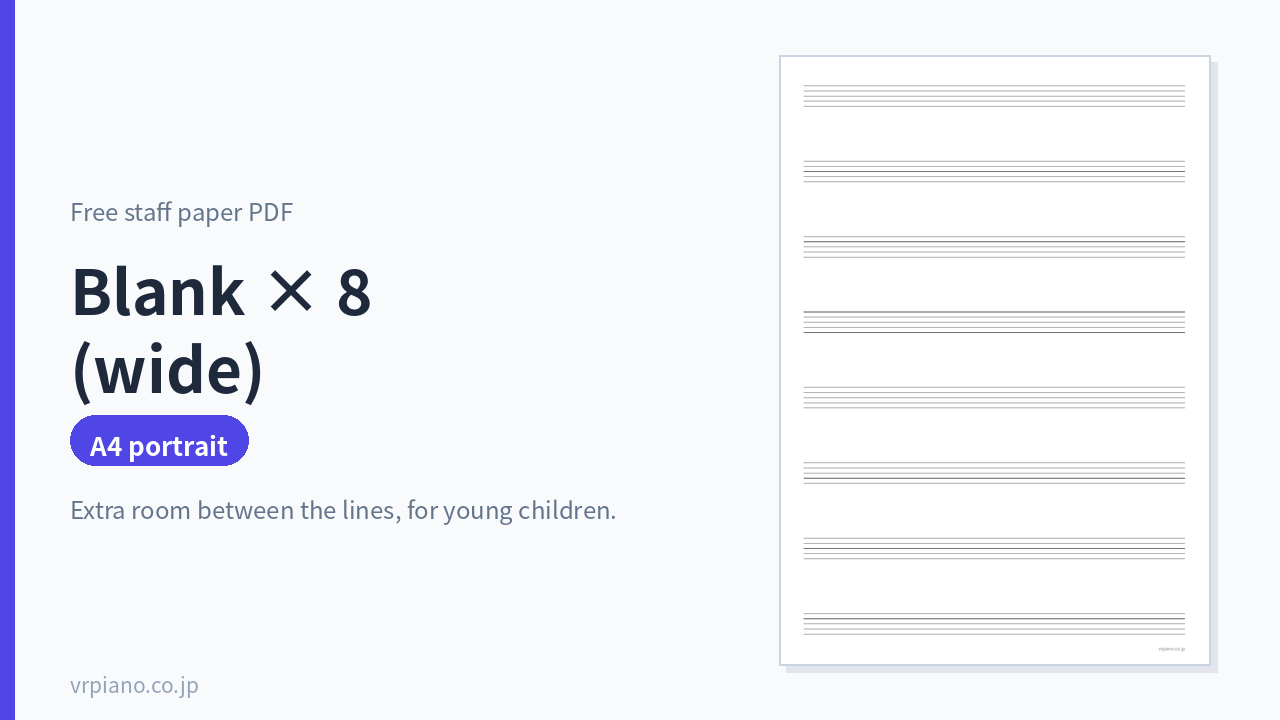
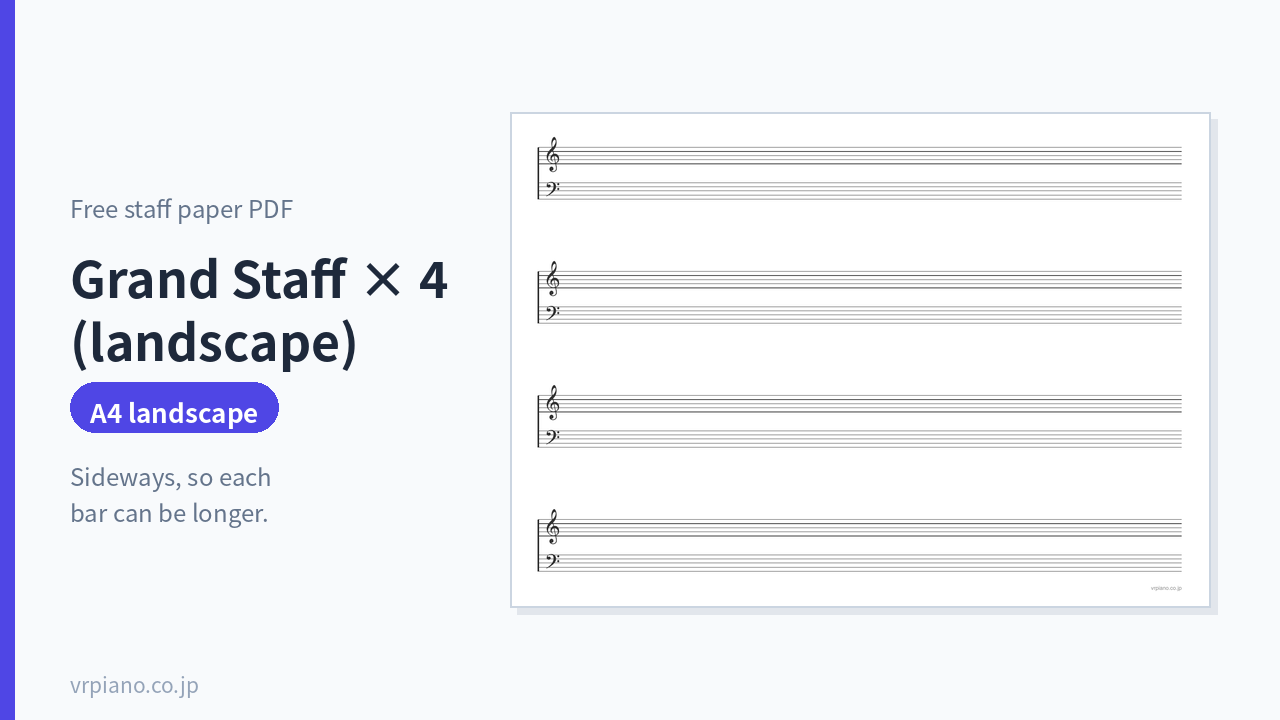
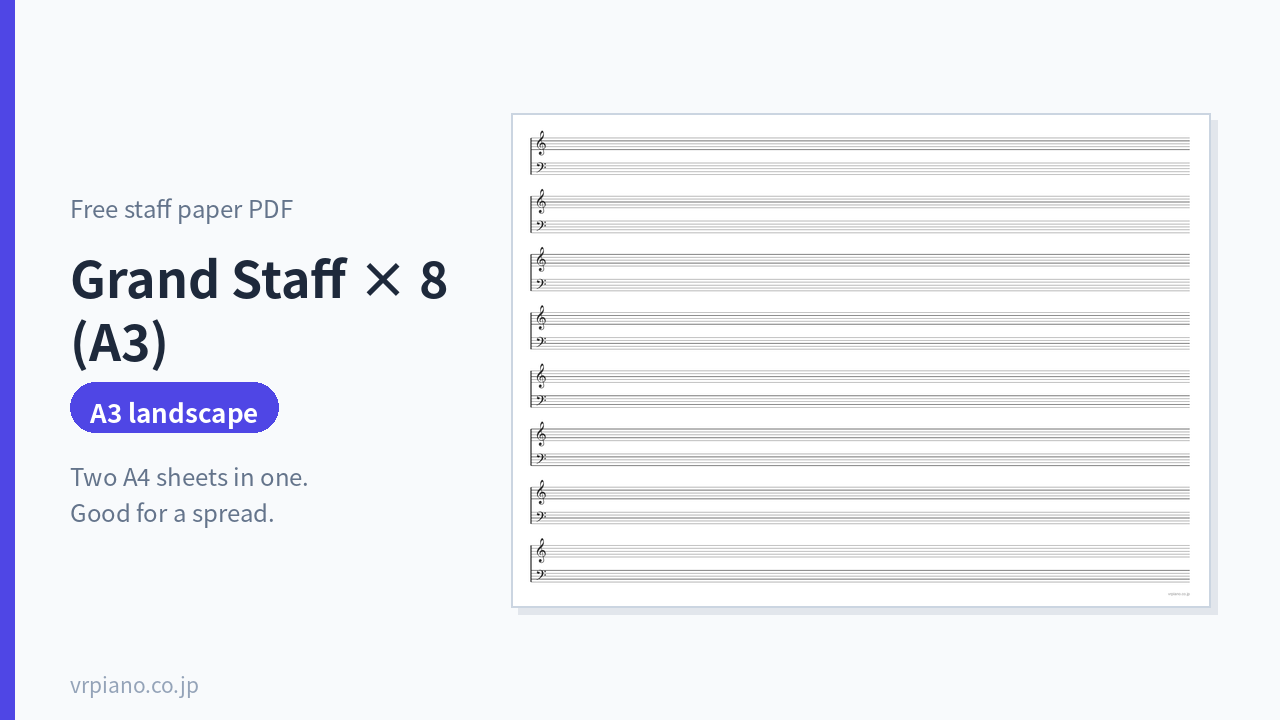
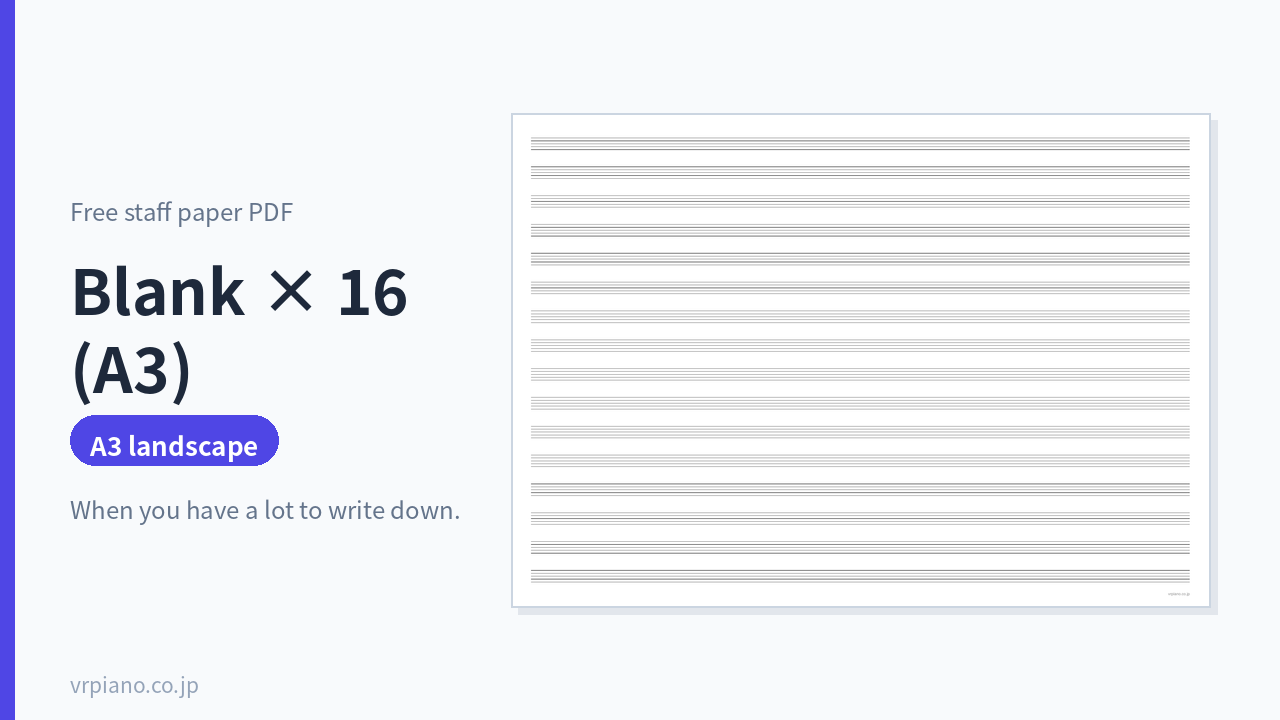
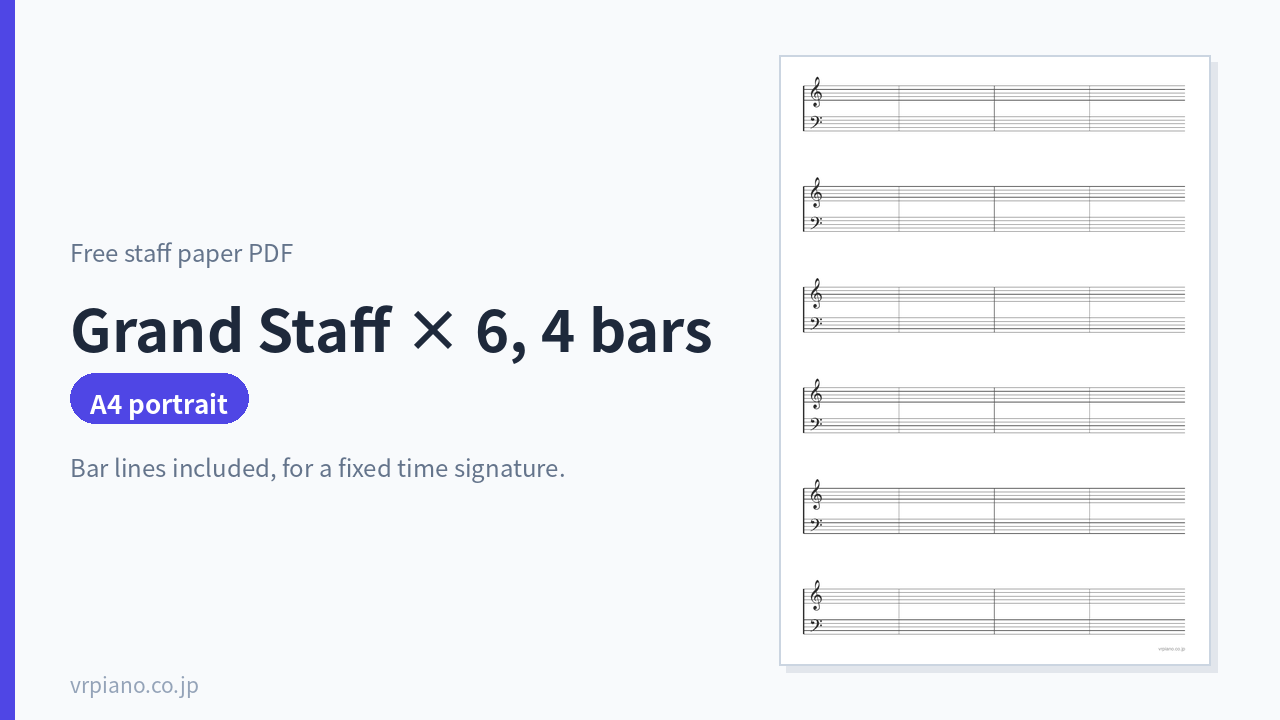
Not sure which one? Take Grand Staff × 6. It is the layout pianists reach for most.
All nine sheets in a single file → Download all nine (9 pages)
Which one should I pick?
| What you want to do | Take this |
|---|---|
| Write down a piano piece | Grand Staff × 6 |
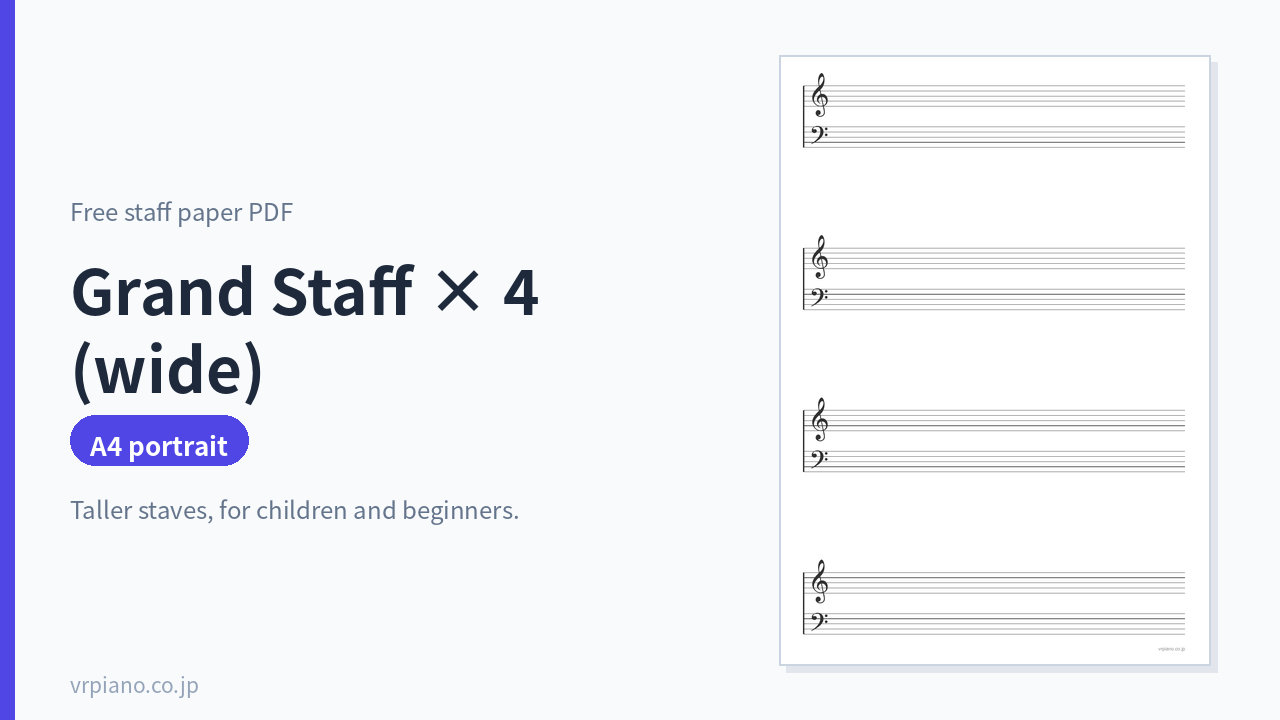
| A child is using it, or you write large | Grand Staff × 4 (wide) |
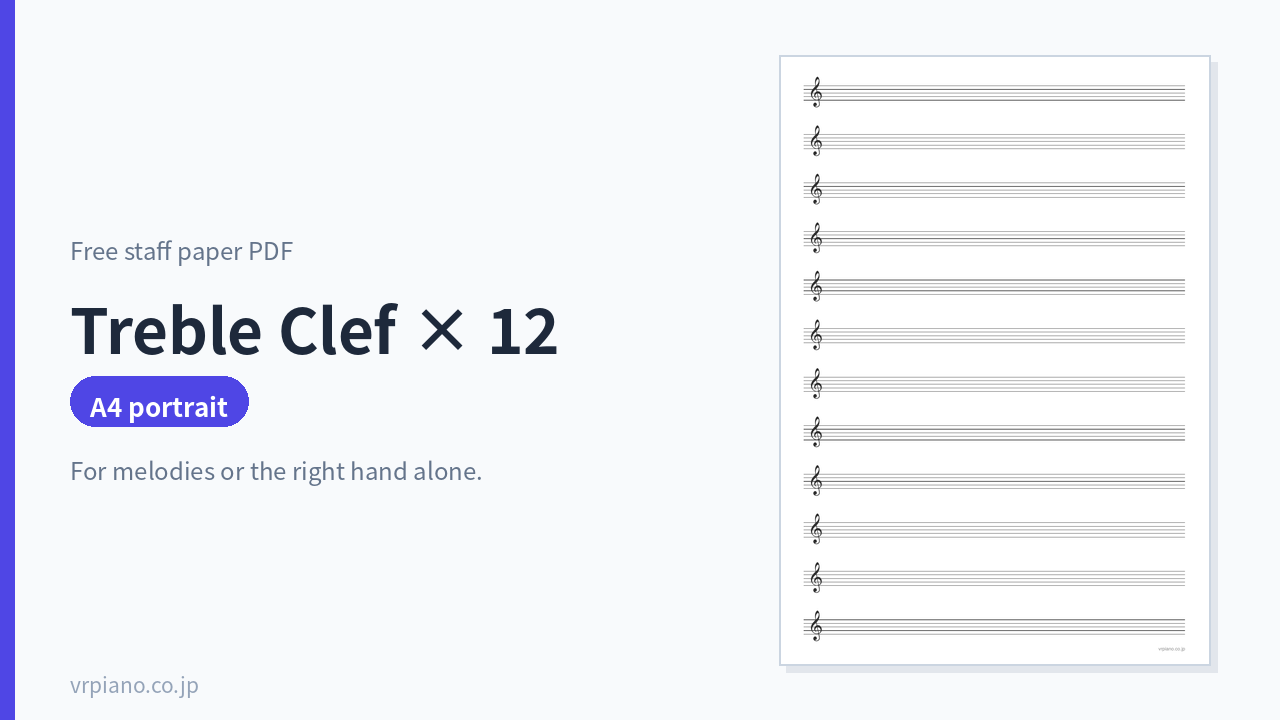
| Write a melody only | Treble Clef × 12 |
| Practise drawing clefs | Blank × 12 |
| Work in a fixed time signature | Grand Staff × 6, 4 bars |
| Give each bar more room | Grand Staff × 4 (landscape) |
| Write a lot, or work on a spread | Either A3 sheet |
Grand staff or single staff?
A grand staff is two staves joined by a brace: treble on top, bass underneath. The piano plays two ranges at once, so the two staves together make one piece of music. Almost all published piano music is written this way.
A single staff is one stave on its own. Use it for a vocal line, or for the right hand alone.
Staff paper sold in shops is mostly single staff, but for piano the grand staff is far more useful. Five of the nine sheets here are grand staff.
Why two sheets have no clefs
The two “Blank” sheets have no treble or bass clef printed on them.
That is on purpose. Drawing the clef is something you have to practise. A treble clef has an odd stroke order, and tracing over a printed one does not teach it — you have to draw it yourself, many times.
They are also handy if you need an alto clef, or if you want the staves for something else entirely.
Printing
- Print at actual size
In the print dialog, under page sizing, choose Actual size or 100%. “Fit to page” shrinks the staves slightly. - The orientation is already set
Each PDF carries its own orientation, so the A4 and A3 landscape sheets print sideways without you changing anything. - No A3 printer?
Choose “shrink to A4” in the print dialog. The staves come out smaller, but you keep the same number of them. - Printing from a phone
Open the PDF, tap share, then Print. Most public copy shops also let you upload a PDF from their app.
The lines are printed in dark grey rather than black. Pencil notes sit on top of them clearly instead of disappearing into them.
Using staff paper
A note sits on a line, or in a space
A stave has five lines, which gives you nine places to put a note: five on the lines and four in the spaces. A note drawn halfway between the two has no pitch.
Draw the note head large enough to straddle its line. Too small and nobody can tell whether you meant the line or the space.
Notes above and below the stave
Notes that do not fit get short extra lines called ledger lines. Middle C sits exactly between the two staves of a grand staff, on one ledger line of its own.
If reading the notes themselves is the part you find hard, you can practise here.
Other things it is good for
- Working something out by ear: write down what you hear so you can come back to it
- Transposing: when the original key is awkward, write it out in a friendlier one
- Fingering: write out just the finger numbers to see the shape of the movement
- Scales: writing out a scale in each key is how key signatures stick
Questions
Is it really free? Do I have to sign up?
It is free, and there is nothing to sign up for. No account, no email address. Press the button above and the file downloads.
Can I print copies for my students?
Yes. Print as many as your lesson or class needs.
Please do not re-host the files on another site, or edit them and sell them.
Staff paper or manuscript paper?
They mean the same thing. Manuscript paper is the usual term in British English; staff paper (or music paper) is more common in American English.
Whichever you searched for, this is the blank ruled paper you write music on.
How tall are the staves?
The standard sheets use 7 mm and the wide ones 10 mm, measured across all five lines. Printed staff paper is generally in that range.
7 mm suits an adult hand. Choose the wide version for young children, or if you write a lot on the page.
Is there a version with bar lines?
Yes — Grand Staff × 6, 4 bars. Each system is divided into four, which keeps the beats lined up when you are writing in 4/4.
Before the time signature is settled, the sheets without bar lines give you more freedom.
Free tools to go with it
- Note Reading Trainer — practise the treble and bass clef
- Virtual Piano — hear what you have written
- Rhythm Trainer — learn note values by tapping them
- Online Metronome — with practice tempos for real pieces
In short
- For piano, use the grand staff. If in doubt, Grand Staff × 6
- Children and beginners want the wide version (10 mm staves)
- To practise drawing clefs, take a blank sheet
- Always print at actual size
Keep a few sheets printed and to hand, so a melody that turns up has somewhere to go. Bookmark this page and you can run off more whenever you run out.