
“Do I actually have rhythm?” If you’ve ever clapped out of time at a concert or caught yourself speeding up at the piano, you’ve probably wondered.
This page lets you test your sense of rhythm right now with 9 rhythm games, from clapping and piano to badminton. Each round takes about 40 seconds, and you get an instant three-level rating. There’s nothing to install and no sign-up. It works on your phone or computer, and you can play as often as you like for free.
- The games play sound. Check your volume before you begin.
- If other people are around, headphones are a good idea (Bluetooth earbuds work too once you run the latency adjustment).
- On an iPhone, no sound plays while silent mode is on. Turn silent mode off before you play.
- How to Play in 3 Steps
- What This Rhythm Test Measures
- The 9 Games and the Rhythm Skills They Test
- Clap Trio: Keep the Same Gap
- Note Catch: Aim for 2 Beats After the Cue
- Echo Piano: Copy the Rhythm You Hear
- Badminton Rally: Hold the Tempo
- Bouncy Ball: Count the Pads, Then Tap
- Round the Clock: Watch, Remember, Repeat
- Live Show: Answer Each Call with the Right Rhythm
- Rock Step: Switch Between On-Beat and Off-Beat
- Veggie Patch: Remember the Pattern and Tap
- How Your Score Is Rated (Superb, Average, Try Again)
- If You Feel Your Sense of Rhythm Is Weak
- Frequently Asked Questions
- Try Our Pitch Tests Too
- Summary
How to Play in 3 Steps
- Adjust for latency
Press “Adjust” below the menu and tap 8 times along with the metronome. The test measures the audio delay of your phone or headphones and subtracts it when scoring your taps. - Pick a game
Choose any of the 9 tiles and press “Start”. The music begins, and the first few easy cues act as a warm-up. You can tap anywhere on the screen. - Check your rating
After about 40 seconds you get one of three ratings: “Superb”, “Average” or “Try Again”. You also see your results for each type of cue, plus a quick tip for the part you found hardest.
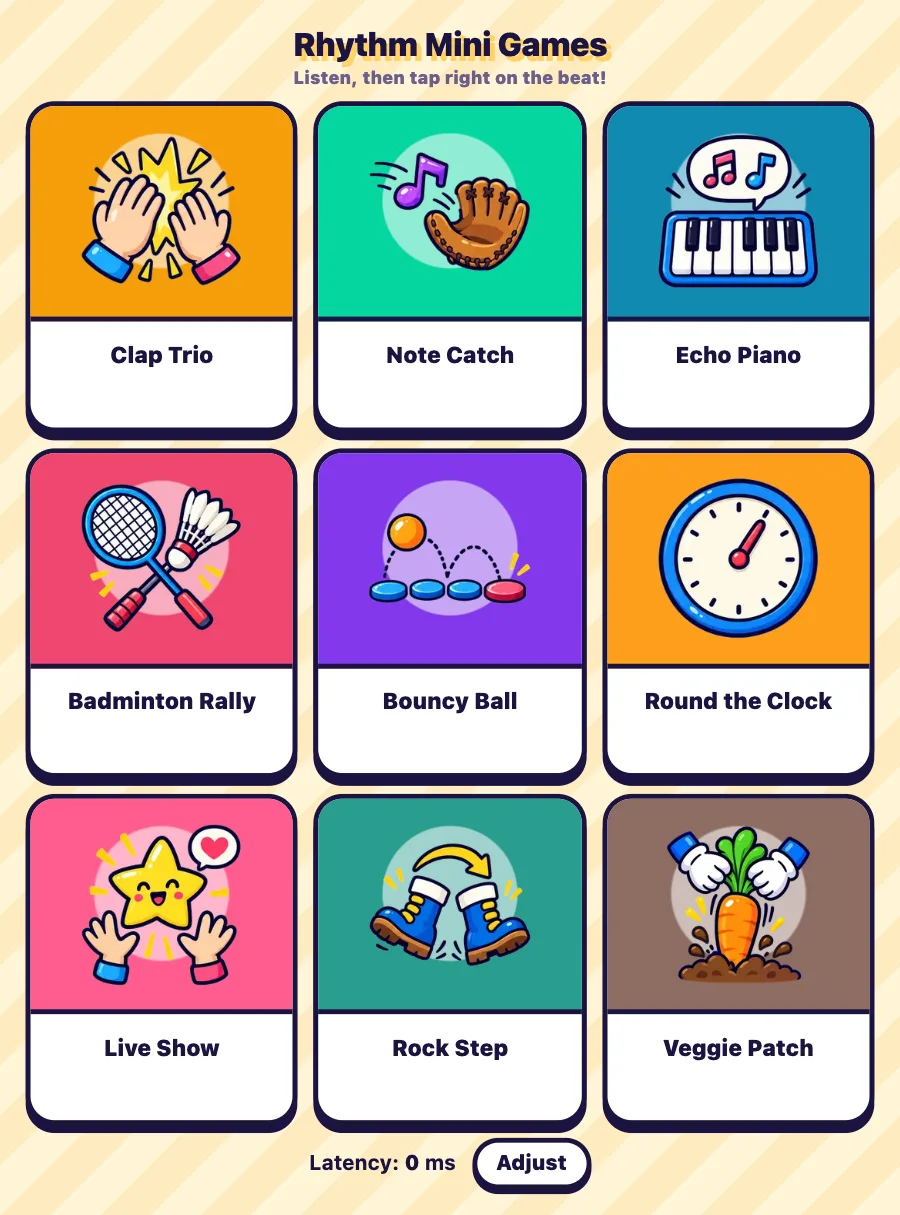
What This Rhythm Test Measures
“Sense of rhythm” isn’t one single skill. It breaks down into several abilities. Some people can hold a steady tempo just fine, yet fall apart as soon as the off-beats come in.
That’s why each game tests a different ability.
| Rhythm skill | What it means | Games that test it |
|---|---|---|
| Hearing intervals | Listening to the gap between two sounds and predicting when the next one will come | Clap Trio |
| Counting and waiting | Waiting a set number of beats after a cue, then tapping | Note Catch, Bouncy Ball |
| Copying a rhythm by ear | Hearing a rhythm once and playing it back exactly | Echo Piano, Round the Clock |
| Keeping a steady tempo | Taking turns with a partner while keeping the same gap | Badminton Rally |
| Syncing with what you see | Following something moving on screen and tapping at the exact moment | Bouncy Ball, Round the Clock |
| Call and response | Recognizing a cue and answering right away with a set rhythm | Live Show |
| Switching between on-beat and off-beat | Moving between the on-beat and the off-beat when cued | Rock Step |
| Remembering patterns | Reading ahead from what you see and getting ready for the next rhythm | Veggie Patch |
You don’t need a perfect score on everything. Play a few games and look at the gap between the games you ace and the ones you struggle with. That shows you your personal rhythm habits. Note that this test is a practice guide, not a professional assessment.
The 9 Games and the Rhythm Skills They Test
Clap Trio: Keep the Same Gap
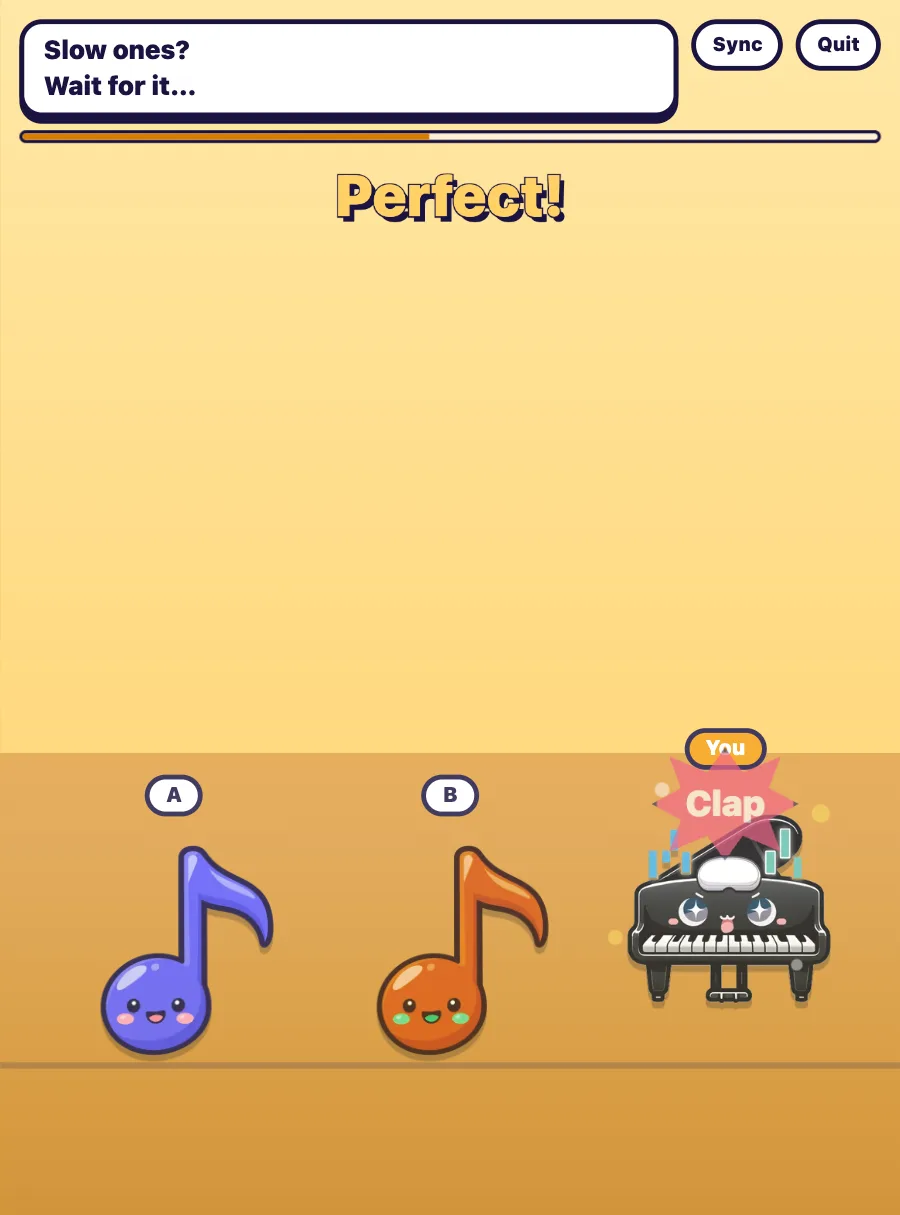
Three players stand in a row. The two on the left clap one after the other, then you clap third, keeping the same gap. Besides “Normal”, the gap sometimes comes at half length (“Fast”) or double length (“Slow”).
This game tests how well you hear the gap between two sounds and predict the next beat. “Slow” is where scores really split: it’s easy to get impatient and clap too early.
Tip: as the two claps play, count “1, 2, 3” in your head and wait to clap on 3.
Note Catch: Aim for 2 Beats After the Cue
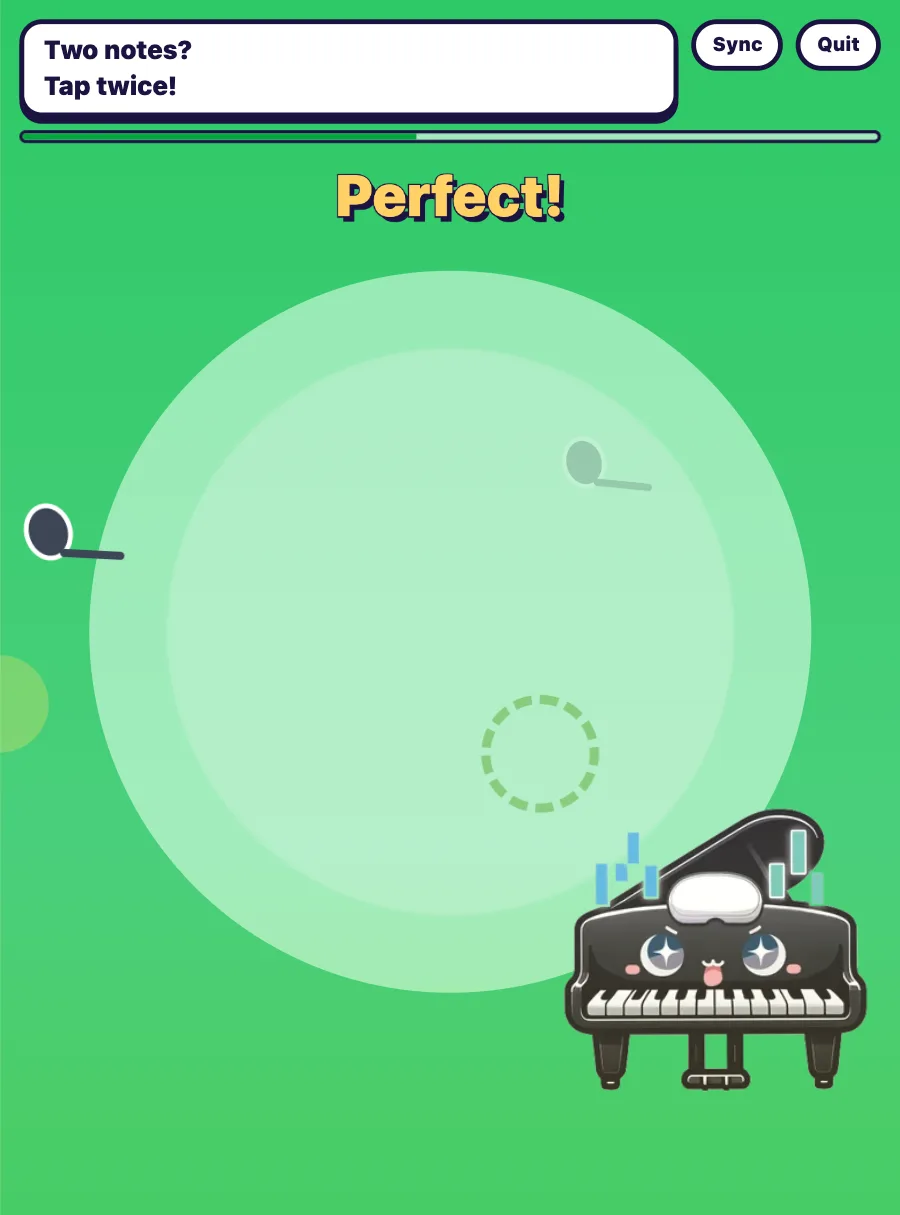
A note flies out with a “Pop!” and reaches Shigure exactly 2 beats later. Tap right then to catch it. Sometimes two notes come in a row (“pa-pop”), or three (“pa-pa-pop”).
This game tests your ability to count and wait a set length after a cue. Another key point is whether you can catch the second and third notes with the same spacing as the first.
Tip: count “Pop, 1, 2” silently in your head.
Echo Piano: Copy the Rhythm You Hear
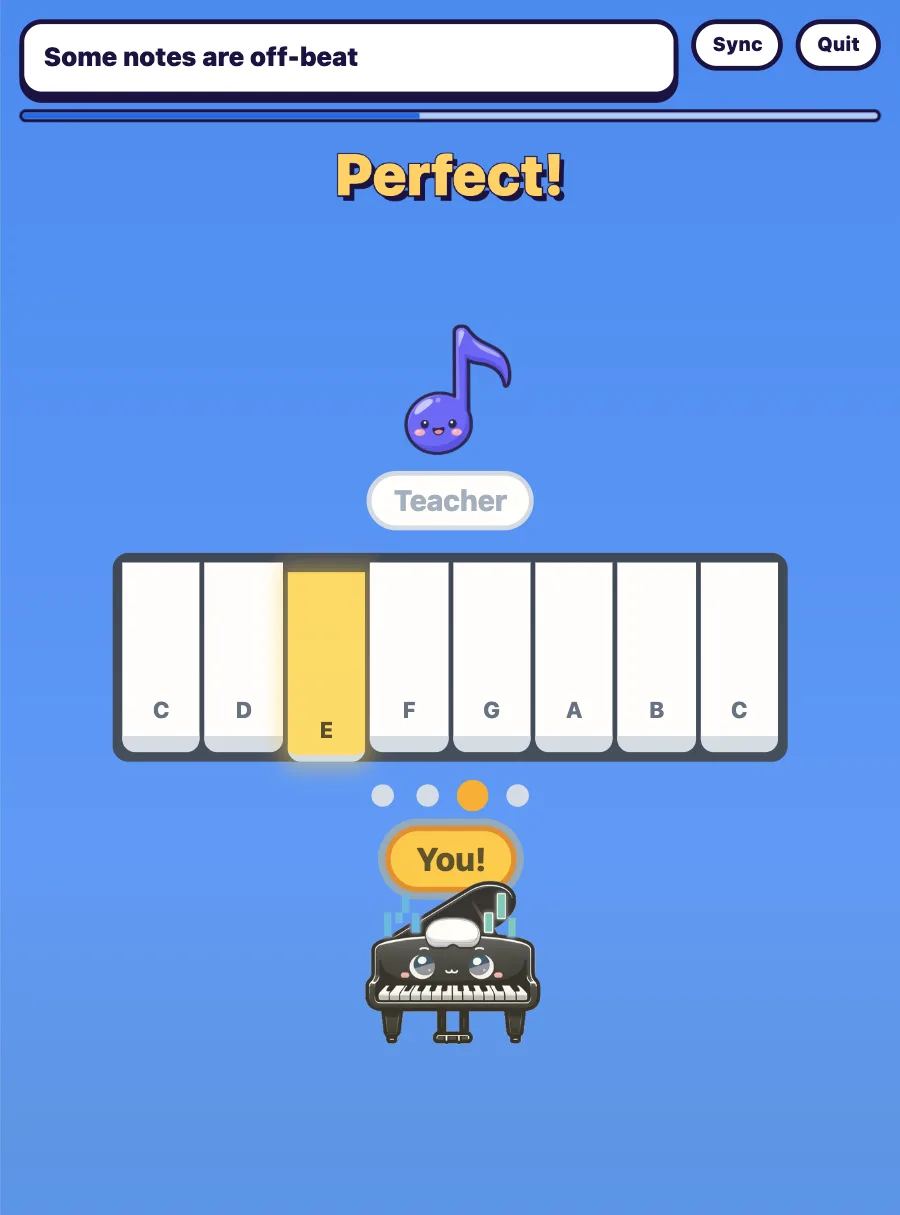
The teacher plays a one-bar phrase, then you copy the same rhythm in the next bar. Each tap plays the teacher’s notes in order, so if your rhythm is right, it turns into the same melody. There are 8 phrases, from simple ones to ones with off-beat notes.
This game tests how well you can memorize a rhythm on the spot and reproduce it. It’s the same skill you use when copying your teacher in a lesson.
Tip: while the teacher is playing, say the rhythm out loud, like “tan, ta-ta, tan”.
Badminton Rally: Hold the Tempo
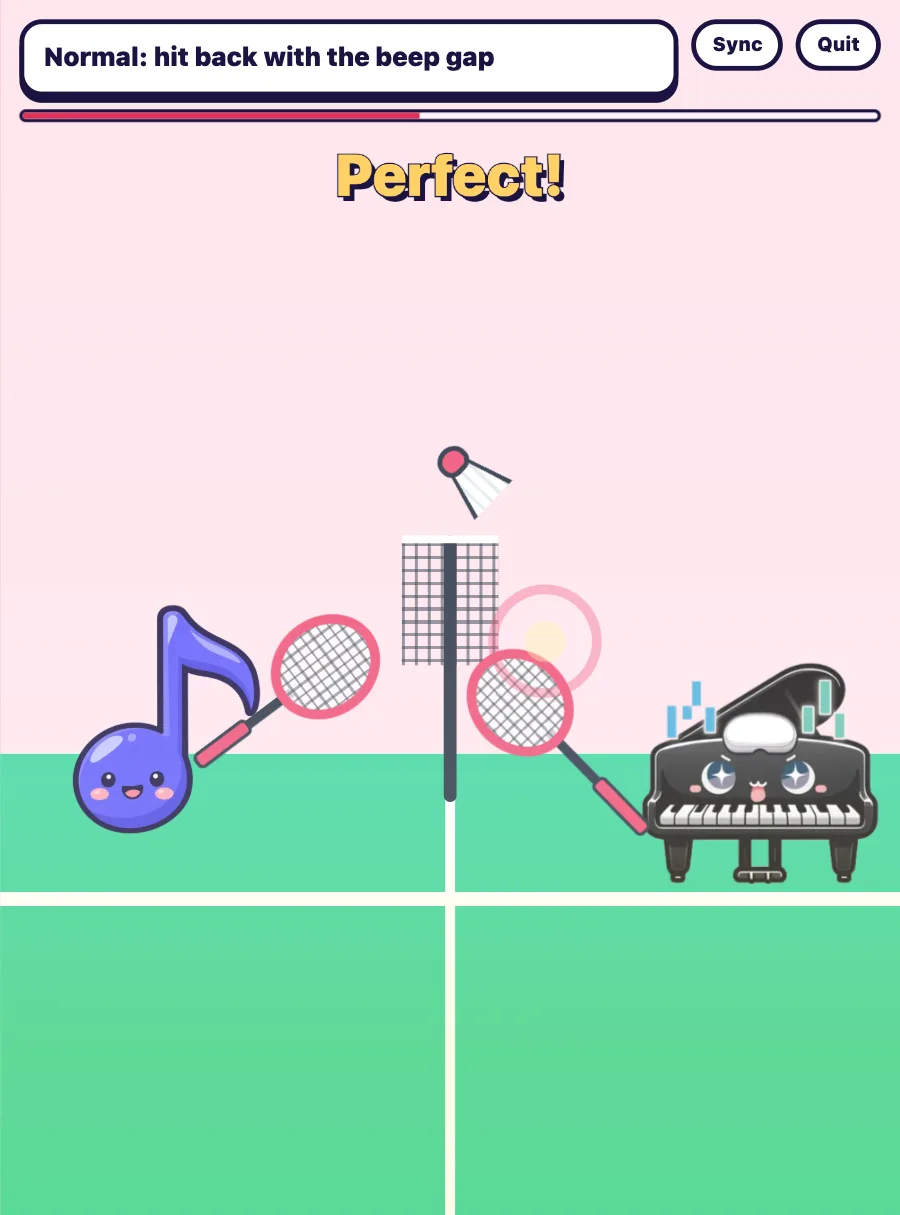
Following the gap set by a “beep, beep” cue, you and your opponent take turns hitting the shuttlecock. There are three tempos: “Normal”, “Slow” and “Fast”.
This game tests your ability to keep the same tempo all the way to the end. Since your hits alternate with your opponent’s, the key is to feel their hit as part of the beat. It also shows whether you tend to rush or drag.
Tip: on “Slow”, don’t hurry and wait it out; on “Fast”, say “ta-ta-ta” out loud to lock in.
Bouncy Ball: Count the Pads, Then Tap
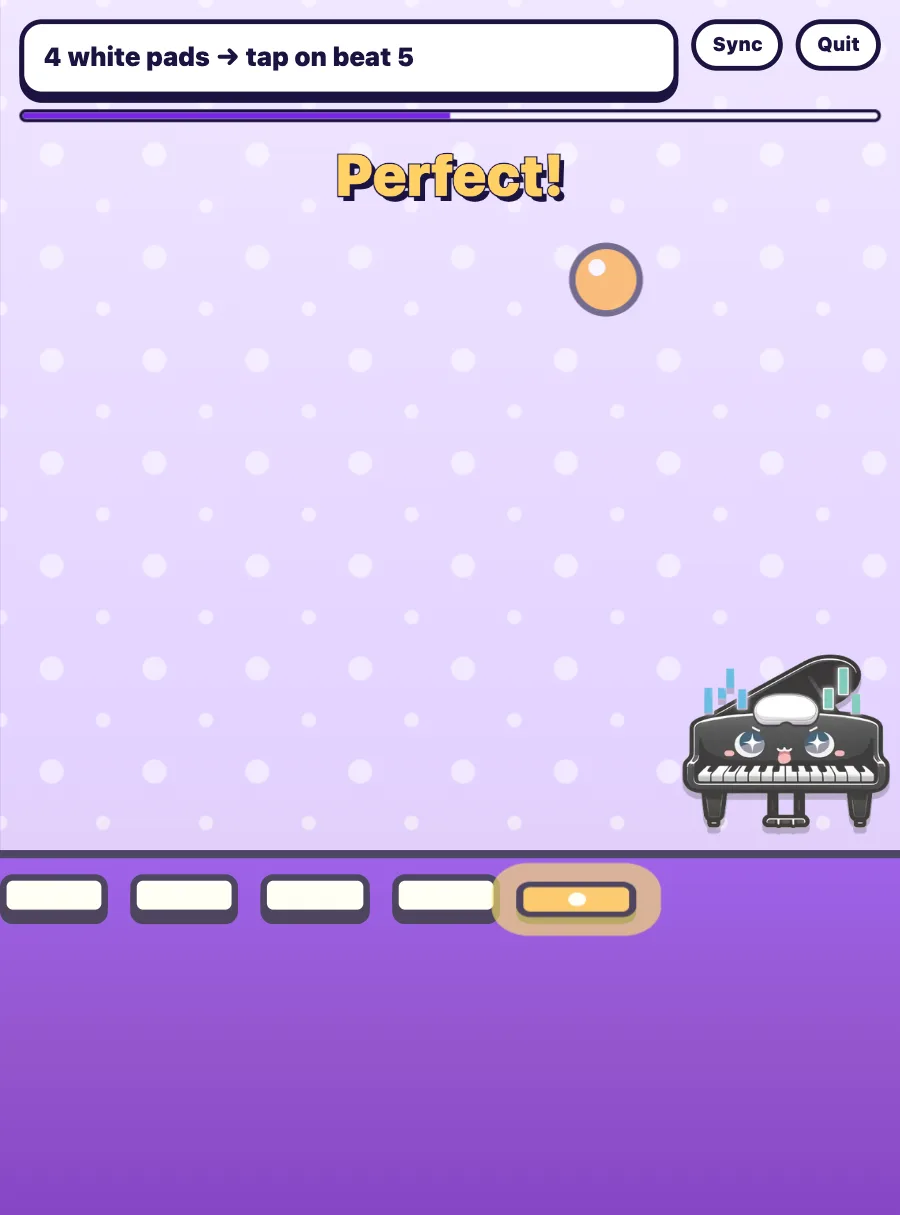
White pads and a red pad line the floor, and a ball bounces across the white pads one beat at a time. Tap the moment it lands on the red pad. The number of white pads changes every time (2 to 4), and “Fast” balls that bounce every half beat also show up.
This game tests both your beat counting and your ability to sync with what you see. It shows whether you can look at the pads and work out how many beats are left.
Tip: check how many pads there are before the ball starts moving.
Round the Clock: Watch, Remember, Repeat
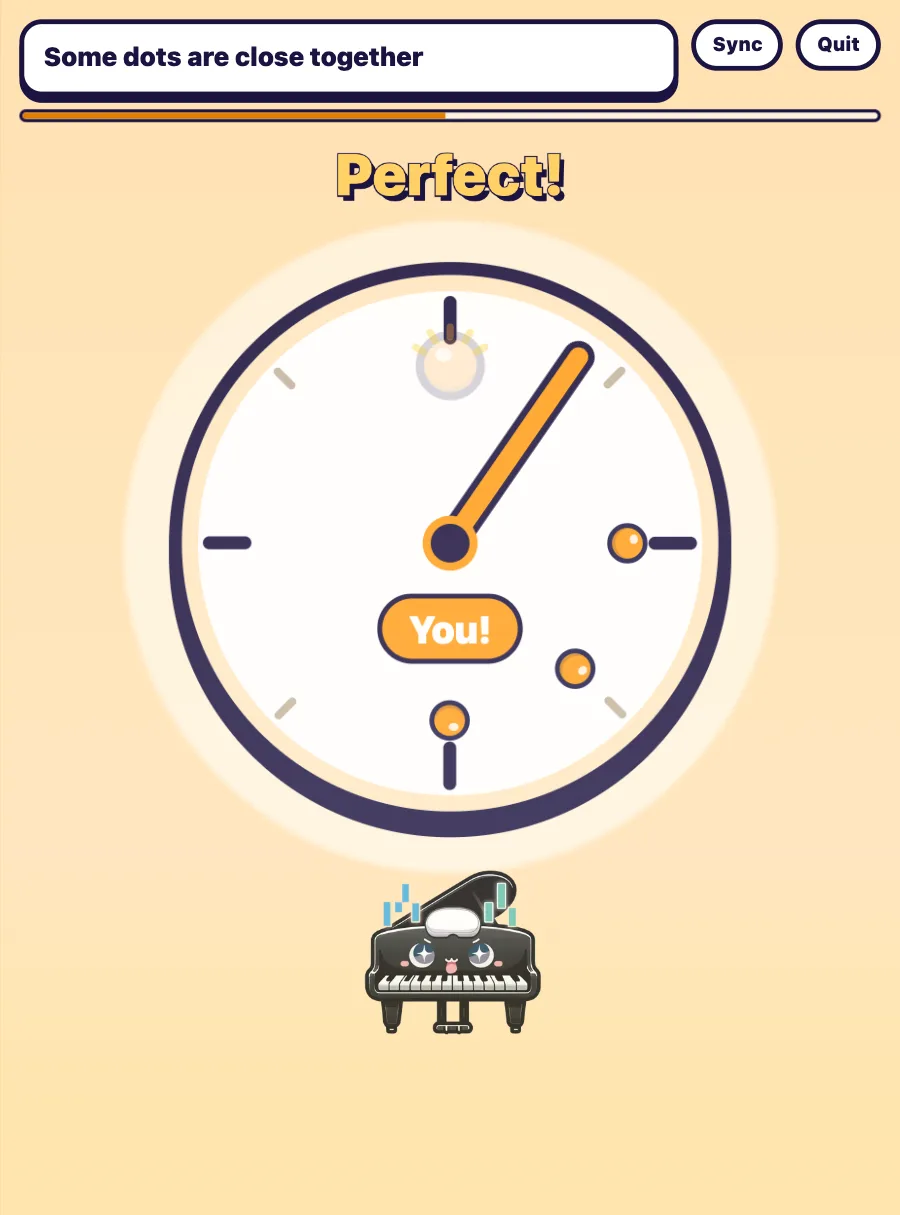
A big clock whose hand goes around once per bar. Lap 1 is the demo: a sound plays at each dot. On lap 2, tap the moment the hand passes the same dots. There are three kinds of patterns: “On the beat”, “Quick notes” and “Syncopated”, which doesn’t start on the downbeat.
This game tests how well you connect the timing you see with the rhythm you hear. The “Syncopated” patterns also test your feel for off-beats.
Tip: use the clock’s tick-tock as your beat marker.
Live Show: Answer Each Call with the Right Rhythm
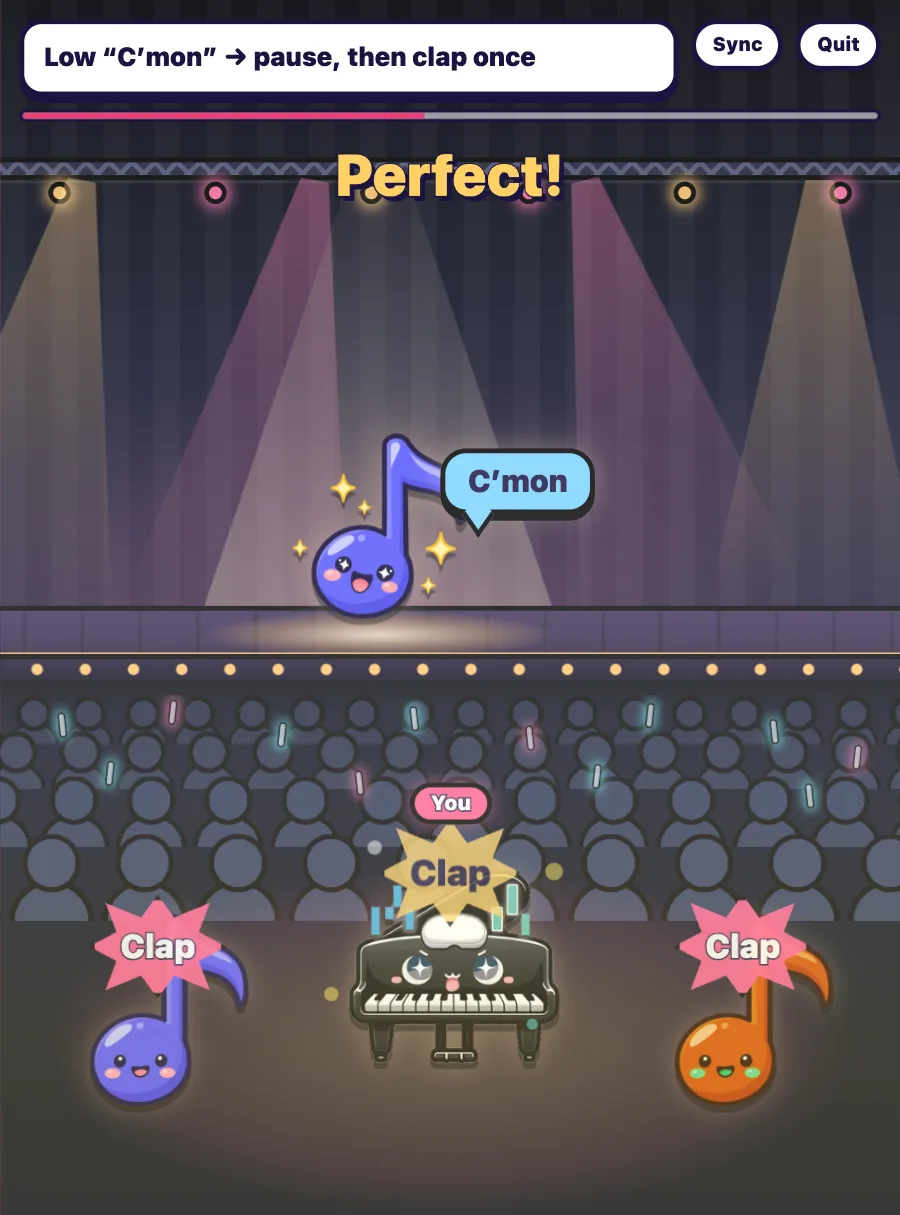
You’re a fan in the crowd, and when the idol on stage calls out, you answer with a set clap pattern. “Hey!” gets two claps, “Yeah!” gets three quick claps, and a low “C’mon” gets a short pause and then a single clap.
This game tests how quickly you can tell the calls apart and answer with the right rhythm. It’s close to the feeling of reacting to cues from other players in an ensemble.
Tip: say each call and its answer together out loud, like “Hey, clap, clap”. The fans next to you clapping along are a hint too.
Rock Step: Switch Between On-Beat and Off-Beat
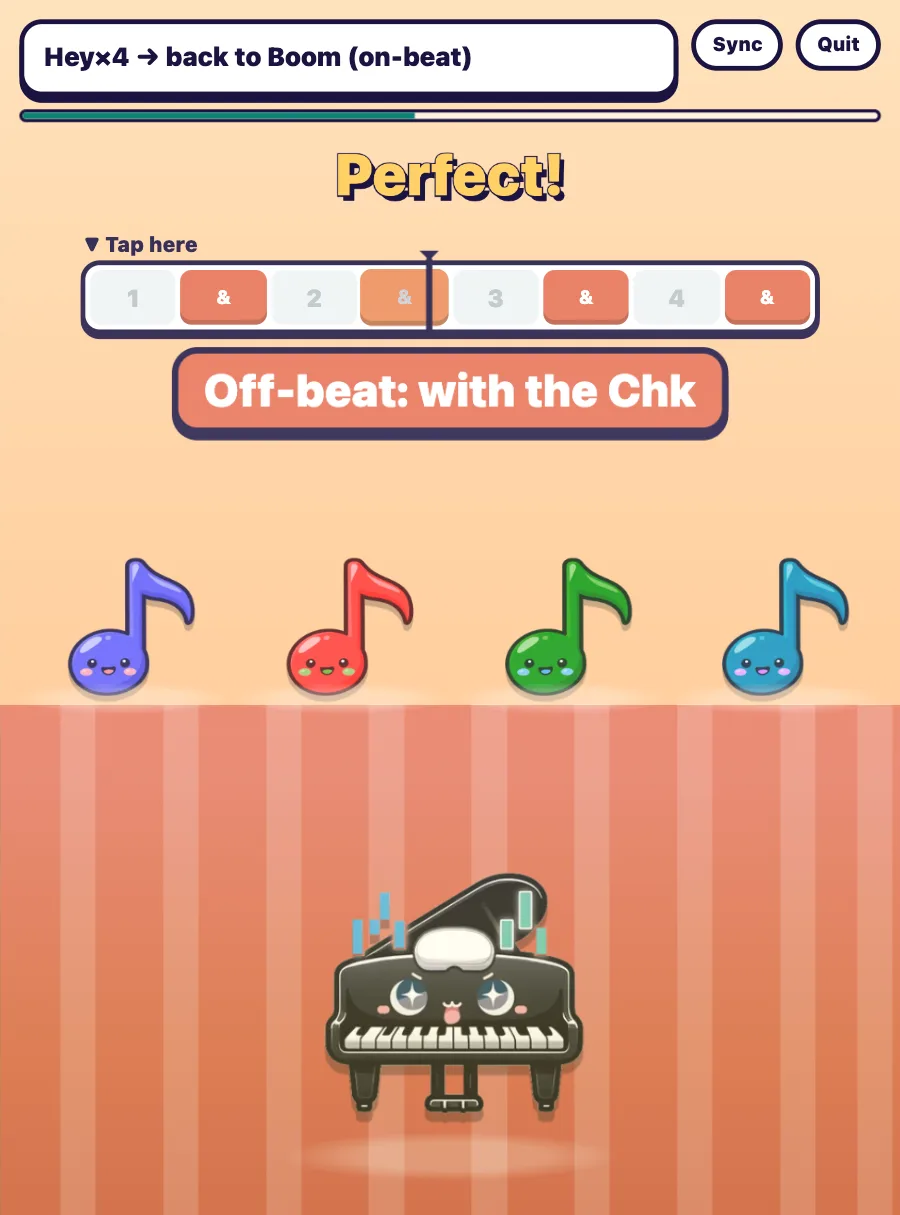
March along with a line of mascots. At first you stomp with the low “Boom” (the on-beat). When the “Hey×4” cue (hey, hey, hey, hey) comes, switch to the “Chk” (the off-beat). When the cue comes again, go back to the on-beat.
This game tests your feel for off-beats and your ability to switch between on-beat and off-beat. On the off-beat, it’s easy to get pulled back onto the beat, which makes this one of the most challenging of the 9 games.
Tip: on the off-beat, say “n-chk” out loud as you bring your foot down.
Veggie Patch: Remember the Pattern and Tap

Pull up the vegetables buried in the patch with a set number of pulls, starting 2 beats after the cue. A carrot takes one pull, a radish takes two (“heave, ho”), and a potato takes three (“pip-pip-pop”). A giant turnip also appears once per round. The order changes every time.
This game tests your ability to remember patterns and to read ahead and get ready. You can already see the next vegetable, so it feels a lot like reading a little ahead in the sheet music as you play.
Tip: while you’re pulling up one vegetable, get the next vegetable’s rhythm ready in your head.
How Your Score Is Rated (Superb, Average, Try Again)
Scoring Criteria
Every tap is scored by how far it lands from the target timing. Here’s how it works:
| Judgment | Timing error | Points |
|---|---|---|
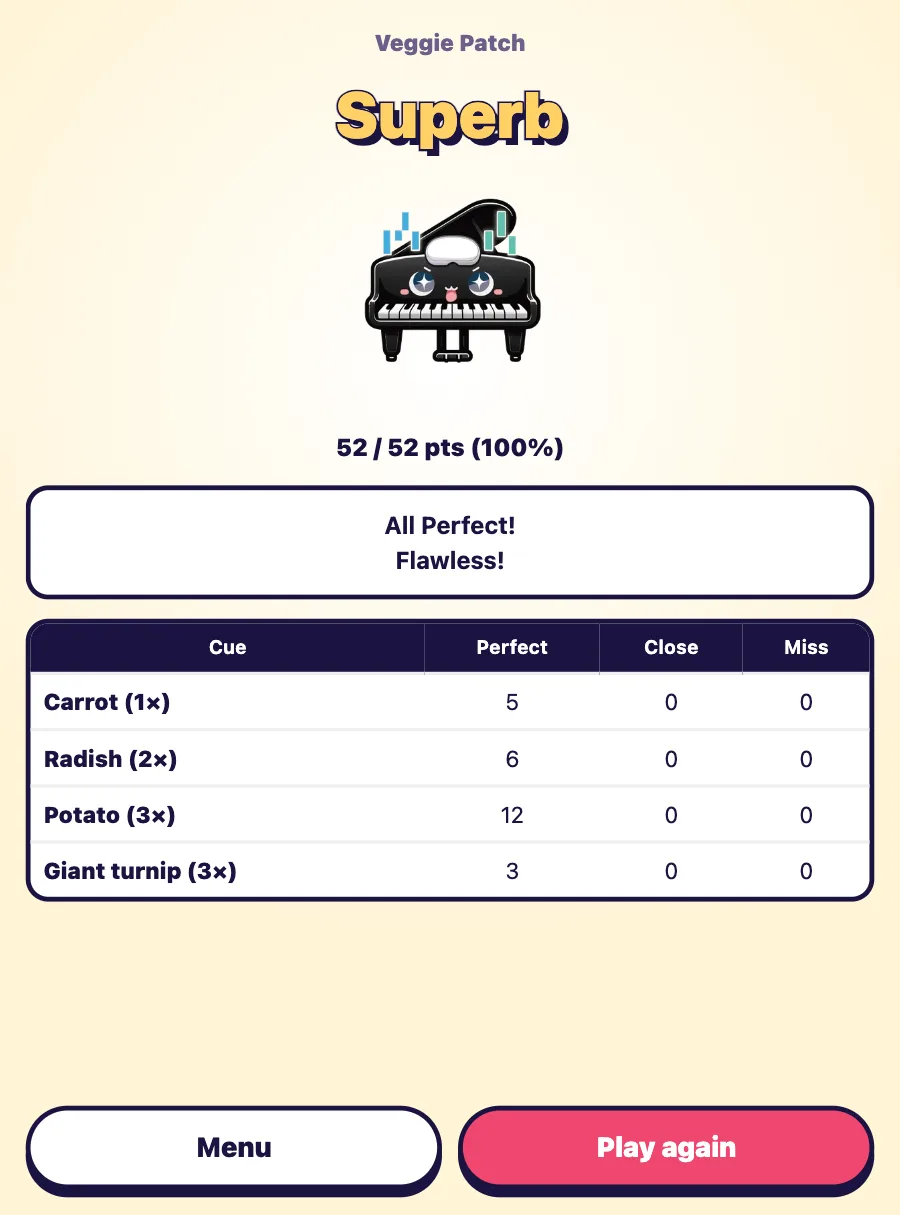
| Perfect | Within ±0.05 seconds (50 ms) | 2 points |
| Close | Within ±0.11 seconds (110 ms) (also shows “Early” or “Late”) | 1 point |
| Miss | Off by more than that, or no tap | 0 points |
At the end of the game, your points are divided by the maximum score, and that percentage determines your rating:
- Superb: 85% or higher
- Average: 55% or higher
- Try Again: below 55%
The results screen shows how many “Perfect”, “Close” and “Miss” you got for each type of cue, plus a tip for the cue you struggled with most. Your personal best is saved on the menu.
How the Latency Adjustment Works
Phones and computers have a slight delay before a sound actually plays. Bluetooth earbuds in particular tend to add a lot of delay, so without an adjustment you can end up with “I was right on the beat, but it says I’m late.”
That’s why the test first asks you to tap 8 times with a metronome and automatically measures the delay on your setup. The measured value is subtracted when your taps are scored, so whether you use headphones or speakers, you’re rated fairly for your setup. The value is saved on your device, so you don’t need to measure again next time.
If your timing ever feels off during a game, you can redo it at any time with the “Sync” button in the top-right corner of the screen.
If You Feel Your Sense of Rhythm Is Weak
Getting “Try Again” over and over is nothing to feel down about. A sense of rhythm usually improves bit by bit with practice. Here are three ways to practice.
Use a Metronome to Notice When You Drift
The first step is noticing when you’re off. Set a metronome to a slow tempo and clap or play a simple piece along with it. You’ll start to see your own habits: whether you tend to rush or to drag. There’s also a free online metronome you can use in your browser.
Learn Note Lengths with Your Body
If your rhythm slips when you read sheet music, you may be unsure of the note lengths. Even if you understand them in your head, your timing will drift until your hands have learned them. Rhythm Training helps you learn note lengths by tapping them out.
5 Minutes of Games a Day
In our experience, practicing a little every day sticks better than one long session a week. Playing one or two games of this test a day is good practice, too. We also recommend the piano game for getting your fingers moving.
Frequently Asked Questions
Q1. Can adults still improve their sense of rhythm?
A. We believe much of it can be improved. Practice like counting beats, saying rhythms out loud and playing along with a metronome works at any age. Rather than aiming for perfection right away, we recommend tackling the patterns you find hard one at a time.
Q2. How long does the test take?
A. Each game lasts about 40 seconds. Even if you play all 9, it takes around 10 minutes including reading the instructions. You can also just try the one game you’re curious about.
Q3. Is it free? Do I need to sign up?
A. It’s completely free, with no sign-up and no app to install. Just open this page to start playing, and play as many times as you like.
Q4. Can I play on my phone?
A. Yes. Hold your phone upright and tap anywhere on the screen. On a computer, you can click the mouse or press the Space key. On an iPhone, no sound plays in silent mode, so turn it off before you start.
Q5. My timing is judged wrong with Bluetooth earbuds
A. Bluetooth earbuds often delay the sound, so without an adjustment your taps are judged as late. Press “Adjust” on the menu, or “Sync” during a game, and tap 8 times with the metronome. The test measures the delay on your setup and subtracts it when scoring. If it says the delay is very large, wired headphones or your device’s built-in speaker will work better.
Q6. The scoring feels too strict (or too lenient)
A. First, try running the latency adjustment again. You can also fine-tune the result with the “−10” and “+10” buttons that appear after the adjustment. “Perfect” requires being within ±0.05 seconds, which is deliberately on the strict side. Even an “Average” rating is usually good enough for everyday playing, so don’t worry about it too much.
Try Our Pitch Tests Too
Besides rhythm, why not test your ear for pitch as well? Both are free and play instantly in your browser.
You’ll find more practice tools, like a metronome and rhythm training, on our free tools page.
Summary
This rhythm test uses 9 rhythm games to check your sense of rhythm from many angles, such as hearing intervals, counting and waiting, and feeling the off-beat. With the latency adjustment done, you’re judged fairly whether you use headphones or a phone speaker.
The games where you scored lowest are where you have the most room to grow. Play a little every day and enjoy watching your ratings change.
If you’d like to build your sense of rhythm while playing the piano, take a look at VR Piano lessons.