The Circle of Fifths is a circular diagram that shows the relationships between musical keys.
But just staring at the diagram tends to leave you at “okay, so how do I actually use this?”
So we built an interactive, sound-based Circle of Fifths. Pick a key and the chords used in that key light up on the circle. You can even hear the Canon progression or the Komuro progression played on real piano sound.
If you can’t hear anything, turn off silent mode and reload the page.
Where chord progressions like the Canon progression and Komuro progression move around the circle is explained here.
- How to Use the Circle of Fifths
- What Is the Circle of Fifths?
- How to Memorize the Circle of Fifths [With a Mnemonic]
- The Chords Used in a Key Fit Within 3 Columns of the Circle
- How Keys and Modulation Work
- Ways to Use the Circle of Fifths
- Frequently Asked Questions
- Free Tools to Use Alongside This One
- Summary
How to Use the Circle of Fifths
- Pick a key
The outer ring is major keys, the inner ring is their relative minor. Press one and you’ll hear the tonic chord. - Look at the 3 lit-up columns
The chords used in the key you picked get marked with I・ii・iii・IV・V・vi・vii°. You’ll see they all fit within 3 columns of the circle. - Play a chord progression
Press the buttons below to play things like the Canon progression, and a light moves around the circle. Change the key and it transposes automatically.
Press “Show key signatures” and each of the 12 keys’ key signature (number of sharps or flats) appears on a staff. You can switch between treble and bass clef.
What Is the Circle of Fifths?
The Circle of Fifths is a diagram that visually shows the relationships between keys in music.
A key roughly means the scale system a piece is built on, and the Circle of Fifths lets you understand visually how close keys are, and how they change.
The Structure of the Circle of Fifths
The Circle of Fifths generally has the following structure.
- C, with no sharps or flats, sits at the top of the circle.
- Keys with more sharps line up going clockwise, and keys with more flats line up going counterclockwise.
- Each major key’s relative minor is placed just inside it.
Why “Fifths”?
The “fifth” in Circle of Fifths refers to a perfect fifth in music theory.
It’s the interval from one note up to the 5th note (degree) of the scale. The Circle of Fifths is the result of laying out notes based on this “fifth.”
The interval of a fifth is one of the most stable-sounding intervals in music theory. This property is what makes natural, well-balanced modulations and chord progressions possible.
Following this perfect fifth one step at a time is itself used as a chord progression, called the fifths progression. If you’d like to feel the Circle of Fifths on the keyboard, here’s more.

How to Memorize the Circle of Fifths [With a Mnemonic]
The Circle of Fifths tends to seem like something you have to memorize by rote, but there are really only 3 things you need to know.
Trick 1: The Number of Sharps/Flats = the Clock Position
This is the easiest one. Just think of it as a clock face.
- Clockwise: 1 o’clock = 1 sharp, 2 o’clock = 2 sharps, 3 o’clock = 3 sharps……
- Counterclockwise: 11 o’clock = 1 flat, 10 o’clock = 2 flats, 9 o’clock = 3 flats……
G major sits at 1 o’clock, so it has 1 sharp. D major sits at 2 o’clock, so it has 2 sharps. The position is the count. There’s nothing to memorize.
Trick 2: The Order of Sharps and Flats Is Just Read Backward
The notes that get sharps or flats follow a fixed order.
| Order added | |
|---|---|
| ♯ | F → C → G → D → A → E → B |
| ♭ | B → E → A → D → G → C → F |
As a mnemonic, the classic way is to chant the sharp order — “F-C-G-D-A-E-B” — as a single rhythmic phrase. Once you can say all 7 letters in one breath, that’s enough.
And here’s where it gets interesting: this order is just the Circle of Fifths itself, traced out.
- F → C → G → D…… is the sequence going up a perfect fifth each time (= clockwise around the Circle of Fifths)
- B → E → A → D…… is the sequence going down a perfect fifth each time (= counterclockwise around the Circle of Fifths)
In other words, once the Circle of Fifths is in your head, you don’t have to separately memorize the order of sharps and flats. You’re looking at the same thing either way.
Trick 3: Naming the Key From the Key Signature
This is the rule for naming a key on the spot when you see its key signature on a score.
For sharps: the key is a half step above the rightmost sharp
With 3 sharps (F, C, G), the rightmost is G♯. A half step above that is A. → A major
For flats: the key is the second-to-last flat, as is
With 4 flats (B, E, A, D), the second-to-last is A♭. → A♭ major
* With just 1 flat there’s no second one, so just memorize it as F major. That’s the only exception.
To find the minor key, take the note 3 steps below (a minor third down) — that’s the tonic of the relative minor. On the tool above, it’s written right on the inner ring.
The Chords Used in a Key Fit Within 3 Columns of the Circle
This is actually where the Circle of Fifths is most useful. It’s also, though, the part that’s hardest to get across from a static image alone.
Pick C major in the tool above, and it lights up like this.
| Position on circle | Left neighbor | Selected key | Right neighbor |
|---|---|---|---|
| Outer (major) | F IV | C I | G V |
| Inner (minor) | Dm ii | Am vi | Em iii |
In other words, the chords commonly used in a key all fit within a “3-column window” on the circle.
And no matter which key you move to, the window just slides along. Pick G major and the window becomes C, G, D. Pick E♭ major and it becomes A♭, E♭, B♭. The relationship stays exactly the same.
Once this clicks, the following becomes clear:
- When you can’t think of a chord, picking from the 6 in the window rarely goes wrong
- When you want to transpose, just slide the whole window sideways
- A chord from outside the window appearing is your signal that it’s a modulation or a borrowed chord
This “7 inside the window” has a name: diatonic chords.
The Circle of Fifths shows them as a positional relationship, but placing the same thing on a keyboard and playing through them one at a time builds a different kind of understanding. The way to read them as scale degrees (“Ⅰ・ⅱ・ⅲ…”) and the steps for arranging the seven into a chord progression are covered in the next article.

Even Famous Chord Progressions All Live Inside This Window
Here are progressions commonly used in Japanese pop music, laid out in C major.
| Progression | Degrees | In C Major |
|---|---|---|
| Canon progression | I–V–vi–iii–IV–I–IV–V | C→G→Am→Em→F→C→F→G |
| Royal Road progression | IV–V–iii–vi | F→G→Em→Am |
| Komuro progression | vi–IV–V–I | Am→F→G→C |
| Two-five-one | ii–V–I | Dm→G→C |
| Circle progression | I–vi–ii–V | C→Am→Dm→G |
None of these ever step outside that 3-column window.
Play these on the tool above, and a light moves back and forth around the circle. You should be able to both see and hear why these progressions sound so satisfying.
- Detailed breakdown of the Canon progression
- Detailed breakdown of the Royal Road progression
- Detailed breakdown of the Komuro progression
- Detailed breakdown of two-five (Ⅱ–Ⅴ–Ⅰ)
- Piano Chord Progressions Roundup
How Keys and Modulation Work

How Closely Keys Are Related
Keys that share a lot of scale notes in common are called closely related keys. For example, from C’s perspective, the neighboring G and F are closely related keys.
The more closely related two keys are, the more natural and well-balanced a modulation between them sounds.
The Circle of Fifths lets you visualize this, which also helps with smooth-sounding modulations.
How to Think About Key Relationships
Key relationships are mainly considered by looking at these 3 keys.
(1) Relative Key
- A major key and a minor key that share the same scale.
- Example: C major and A minor are relative keys, and both have a scale with no sharps or flats.
(2) Dominant Key
- The key whose tonic is a perfect fifth above the original key’s tonic (do).
- Example: C major’s dominant key is G major.
- The dominant key is built around the chord that’s the second most important after the tonic chord within the scale (the dominant chord).
(3) Subdominant Key
- The key whose tonic is a perfect fifth below (or a perfect fourth above) the original key’s tonic (do).
- Example: C major’s subdominant key is F major.
These closely related keys sit right next to each other on the Circle of Fifths.
What Is Modulation?
Modulation is the technique of changing key partway through a piece. Modulating to a closely related key sounds natural and doesn’t strike the listener as odd.
Modulating to a remote key (a distant key), on the other hand, creates a sense of surprise or drama.
Examples of Modulation Based on Key Relationships
(1) Modulating to the Relative Key
- Trait: Since it uses the same scale, this is the smoothest way to modulate.
- Example: Modulating from C major to A minor.
A natural modulation is possible just by slightly changing which chords you choose.
(2) Modulating to the Dominant or Subdominant Key
- Trait: You can modulate by adding just one new sharp or flat to the scale.
- Example: Modulating from C major to G major (dominant) or F major (subdominant).
Since they sit next to each other on the Circle of Fifths, the progression feels well-balanced.
(3) Modulating to a Remote Key
- Trait: Since the key changes drastically, this creates a dramatic effect to the ear.
- Example: Modulating from C major to E major.
Passing through a dominant key or relative key in between keeps things smooth while still achieving a dramatic modulation.
Using the Circle of Fifths for Modulation
Looking at the Circle of Fifths lets you see the relationship between neighboring keys (closely related keys) and remote keys at a glance.
- Closely related keys: Keys next to each other on the Circle of Fifths. Best for smooth modulations.
- Remote keys: Keys on the opposite side of the Circle of Fifths. Use these when you want to create a modulation with an element of surprise.
Try pressing the key opposite whichever one you currently have selected in the tool above. You’ll see the number of sharps or flats jump dramatically. That’s what a “distant key” really is.
Ways to Use the Circle of Fifths
The Circle of Fifths isn’t just a theoretical tool — it can actually be put to use in the following ways.
Helps With Practice

Working through scale or chord practice in the order of the Circle of Fifths lets you master every key efficiently.
For example, practicing major and minor scales in Circle-of-Fifths order builds a natural feel for fingering and how the scales relate to each other.
The scale for each key is collected here.
For Composing and Improvising

When composing or improvising, it’s a useful guide for smoothly modulating through closely related keys.
Using closely related keys keeps the music flowing naturally and sounding well-balanced.
Pop and classical music
Modulating through relative or dominant keys is common.
The melody keeps the same overall mood while still feeling balanced.
Jazz and modern music
Boldly modulating to remote keys creates a sense of surprise.
Understanding Chord Progressions

The Circle of Fifths helps deepen your understanding of the circle progression (I–vi–ii–V) and two-five-one (ii–V–I), both commonly used in popular music and jazz.
On the Circle of Fifths, both take the shape of moving to the left neighbor and then coming back. Trace two-five-one (Dm→G→C) around the circle and you’ll see it lines up neatly: Dm on the inner ring, then G and C on the outer ring.
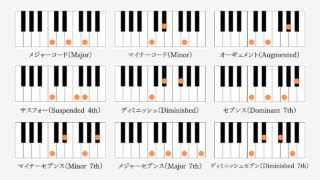
The chord shapes themselves are collected here.
Frequently Asked Questions
Q1. Do I have to memorize the Circle of Fifths?
A. No memorizing needed. As long as you’ve got the number of sharps/flats = the clock position down, you can count it out on the spot.
Unless composing or arranging is your job, being able to look it up when you need it is plenty. Bookmark the tool above.
Q2. Which should I learn first, the outer ring or the inner ring?
A. The outer ring (major keys) alone is enough. The inner minor keys just share the same key signature as the outer ones, so they come along automatically once you know the majors.
Q3. Why are there two labels, like F♯ and G♭?
A. They’re the same pitch — only how they’re written on the score differs (this is called an enharmonic equivalent).
F♯ major has 6 sharps, G♭ major has 6 flats. On the piano, you’re pressing the exact same key. Whichever is easier to read gets chosen depending on the flow of the piece.
Q4. What can I actually do once I know the Circle of Fifths?
A. In practical terms, these 3 things matter most.
- Transposing (doing on paper what changing the key does for karaoke)
- Guessing accompaniment chords (once you know the melody’s key, you can narrow the candidate chords down to 6)
- Noticing modulations (a chord from outside the window is your sign that things have shifted)
Free Tools to Use Alongside This One
- Virtual Piano…… play a keyboard right in your browser. Good for actually pressing chords to check them
- Note Reading Trainer…… practice reading the treble and bass clefs
- Rhythm Trainer…… learn note lengths by tapping
- Online Metronome…… with practice tempos by song
- All-Key Scale Chart…… scales and fingering for all 12 keys
Summary
- The number of sharps/flats = the clock position. Clockwise is sharps, counterclockwise is flats
- The flat order is just the sharp order read backward. Both are tracing the Circle of Fifths
- The chords used in a key all fit within a 3-column window on the circle
- Famous chord progressions all move within that window
- Close keys are neighbors, distant keys are across the circle. The distance tells you how easy a modulation will be
The Circle of Fifths is a powerful tool for understanding and applying music theory.
It’s approachable even for beginners, and useful across scale practice, composing, improvising, and modulating.
Understanding how closely keys relate to each other and putting the Circle of Fifths to use broadens your musical range and builds deeper expressiveness — so go enjoy your music even more!